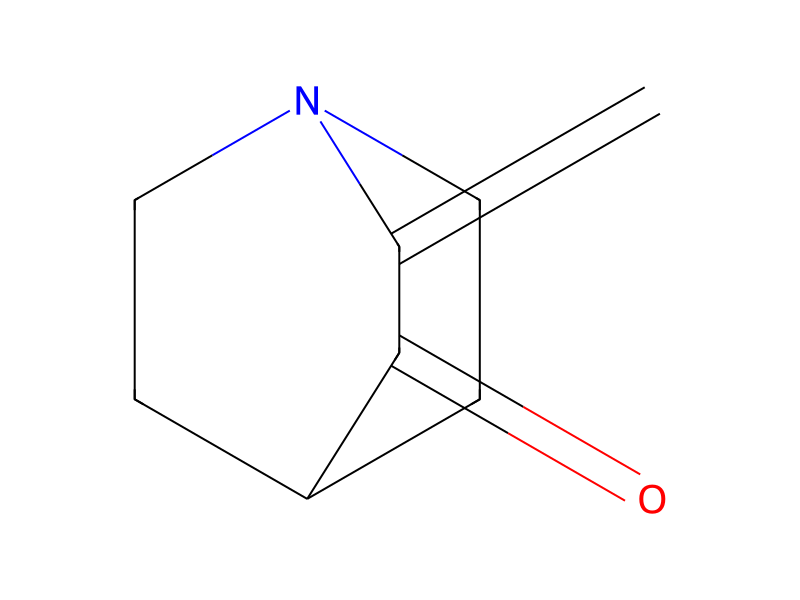
Dichloromethane → 2-Methylene-3-quinuclidone
Reaction equation

Cl.O.O.[CH2:4]=[C:5]1[C:10](=[O:11])[CH:9]2[CH2:12][CH2:13][N:6]1[CH2:7][CH2:8]2.C([O-])([O-])=O.[K+].[K+].C(Cl)Cl>O>[CH2:4]=[C:5]1[C:10](=[O:11])[CH:9]2[CH2:12][CH2:13][N:6]1[CH2:7][CH2:8]2Participants
5
Reactant 3



Product 1
Reagents, catalysts & solvents 1

Procedure
A mixture of 2-methylene-3-quinuclidinone dihydrate hydrochloride (25.7 g, 0.1225 mol, 1 eq) and K2CO3 (67.0 g, 0.4848 mol, 4 eq) is dissolved in 125 mL water and 200 mL CH2Cl2 and is stirred vigorously. After 16 h, the layers are separated and the aqueous layer is extracted with CH2Cl2. The combined organic layers are dried over MgSO4, filtered and concentrated to give 14.75 g (88%) of 2-methylenequinuclidin-3-one as a yellow oil.: MS (ESI) for C8H11NO m/z 138.1 (M+H)+.
Workup
- customthe layers are separated
- extractionthe aqueous layer is extracted with CH2Cl2
- dry with materialThe combined organic layers are dried over MgSO4
- filtrationfiltered
- concentrationconcentrated
Sources & evidence
- ORD record
- ord-dcb969a2416547c180524273a03c886d
- Source dataset
- uspto-grants-2002_12
- Patent number
- US06500840B2
Reaction notes
Loading…