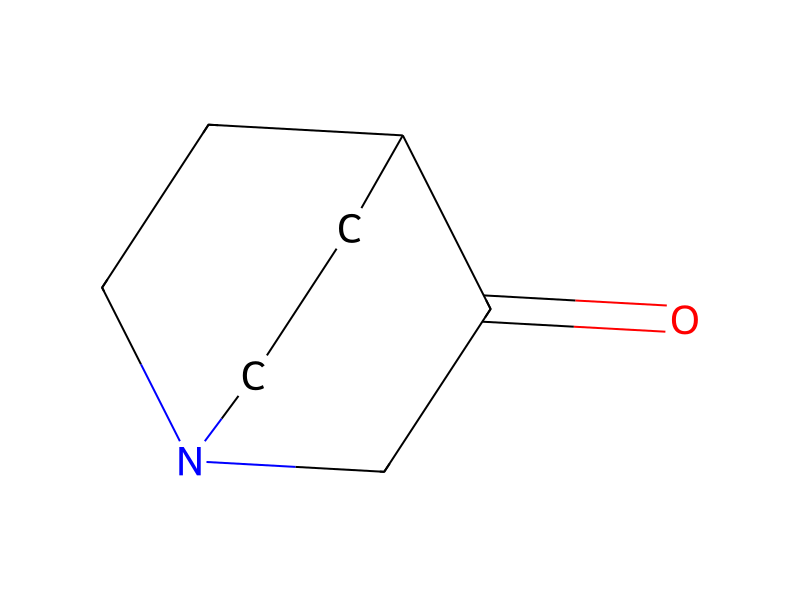
3-Nitrobenzaldehyde → 2-[(3-Nitrophenyl)methylidene]-1-azabicyclo[2.2.2]octan-3-one
Reaction equation

NC1C=C(CC2CC3CCN2CC3)C=CC=1.[N+:17]([C:20]1[CH:21]=[C:22]([CH:25]=[CH:26][CH:27]=1)[CH:23]=O)([O-:19])=[O:18].[N:28]12[CH2:35][CH2:34][CH:31]([CH2:32][CH2:33]1)[C:30](=[O:36])[CH2:29]2.[OH-].[K+]>C(O)C>[N+:17]([C:20]1[CH:21]=[C:22]([CH:23]=[C:29]2[C:30](=[O:36])[CH:31]3[CH2:34][CH2:35][N:28]2[CH2:33][CH2:32]3)[CH:25]=[CH:26][CH:27]=1)([O-:19])=[O:18]Participants





Procedure
The manner in which 2-[(3-aminophenyl)methyl]-1-azabicyclo[2.2.2]octane is synthesized can vary. For example, in one method, 3-nitrobenzaldehyde can be condensed with 3-quinuclidinone in an aldol reaction using potassium hydroxide and ethanol to yield 2-[(3-nitrophenyl)methylene]-1-azabicyclo[2.2.2]octan-3-one. The latter compound can be converted to the corresponding dithioketal by treatment with 1,2-ethanedithiol and boron triflouride etherate. Reduction and desulfurization can be effected by hydrogenation using Raney nickel to yield 2-[(3-aminophenyl)methyl]-1-azabicyclo[2.2.2]octane. Alternatively, in another method, the aldol product, 2-[(3-nitrophenyl)methylene]-1-azabicyclo[2.2.2]octan-3-one can be reduced by treatment with sodium borohydride in methanol to give the alcohol, 2-[(3-nitrophenyl)methylene]-1-azabicyclo[2.2.2]octan-3-ol. The latter compound can be converted to the chloro intermediate, 3-chloro-2-[(3-nitrophenyl)methylene]-1-azabicyclo[2.2.2]octane dihydrochloride upon treatment with thionyl chloride. Dechlorination by hydrogenation with Raney nickel and carbon-carbon double bond reduction by hydrogenation over 10% palladium on carbon can then be effected to yield 2-[(3-aminophenyl)methyl]-1-azabicyclo[2.2.2]octane. Replacement of 3-nitrobenzaldehyde with 2-nitrobenzaldehyde or 4-nitrobenzaldehyde in the above synthetic approach affords the isomeric compounds, 2-[(2-aminophenyl)methyl]-1-azabicyclo[2.2.2]octane and 2-[(4-aminophenyl)methyl]-1-azabicyclo[2.2.2]octane, respectively.
Workup
- customin an aldol reaction
Sources & evidence
- ORD record
- ord-6d8fcabffd304462a48e2826aeecfb1a
- Source dataset
- uspto-grants-2002_08
- Patent number
- US06432975B1
Reaction notes
Loading…