3,5-Dibromopyridine → 3-Bromo-5-(4-methoxyphenoxy)pyridine
Reaction equation

Br[C:2]1[CH:3]=[N:4][CH:5]=[C:6]([Br:8])[CH:7]=1.[CH3:9][O:10][C:11]1[CH:30]=[CH:29][C:14]([O:15]C2C=C(N3CC4CC3CN4)C=NC=2)=[CH:13][CH:12]=1.COC1C=CC([O-])=CC=1.[Na+]>CN(C)C=O>[Br:8][C:6]1[CH:5]=[N:4][CH:3]=[C:2]([O:15][C:14]2[CH:29]=[CH:30][C:11]([O:10][CH3:9])=[CH:12][CH:13]=2)[CH:7]=1Participants


Procedure
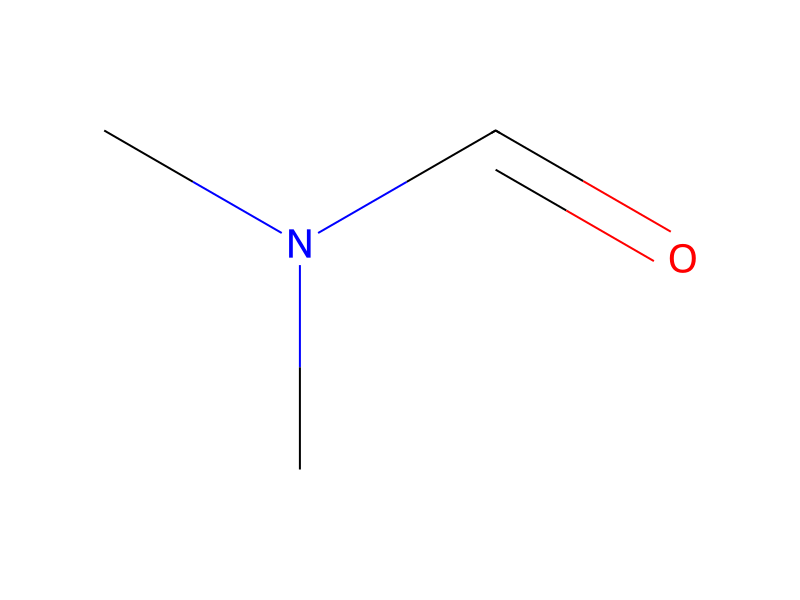
In an alternative approach to the synthesis of pyridine-substituted pyridyl diazabicyclic compounds, 3,5-dibromopyridine can be converted into the corresponding 3-bromo-5-alkoxy- and 3-bromo-5-aryloxypyridines by the action of sodium alkoxides or sodium aryloxides. Procedures such as those described by D. L. Comins et al., J. Org. Chem. 55: 69-73 (1990) and H. J. den Hertog et al., Recueil Trav. Chim. Pays-Bas 74: 1171-1178 (1955), are used. This is exemplified by the preparation 2-(5-(4-methoxyphenoxy)-3-pyridyl)-2,5-diazabicyclo[2.2.1]heptane. Reaction of 3,5-dibromopyridine with sodium 4-methoxyphenoxide in N,N-dimethylformamide gives 3-bromo-5-(4-methoxyphenoxy)pyridine. Coupling of 3-bromo-5-(4-methoxyphenoxy)pyridine with (1S,4S)-N-(tert-butoxycarbonyl)-2,5-diazabicyclo[2.2.1]heptane in the presence of a catalytic amount of tris(dibenzylideneacetone)dipalladium(0) and 2,2′-bis(diphenylphosphino)-1,1′-binapthyl and sodium tert-butoxide in toluene provides (1S,4S)-2-(5-(4-methoxyphenoxy)-3-pyridyl)-5-(tert-butoxycarbonyl)-2,5-diazabicyclo[2.2.1]heptane. Removal of the N-tert-butoxycarbonyl group, using trifluoroacetic acid, produces (1S,4S)-2-(5-(4-methoxyphenoxy)-3-pyridyl)-2,5-diazabicyclo[2.2.1]heptane.
Sources & evidence
- ORD record
- ord-02beb343ed1745068f408ec88388a07e
- Source dataset
- uspto-grants-2002_08
- Patent number
- US06440970B1
Reaction notes
Loading…