Formaldehyde → 2,6-Dihydroxybenzaldehyde
Reaction equation

[C:1]1([OH:7])C=CC=CC=1.C(C1C=CC=CC=1O)(CC(C)(C)C)(C)C.C=O.[C:25]1([CH:32]=[CH:31][CH:30]=[C:28]([OH:29])[CH:27]=1)[OH:26]>C([O-])(=O)C.[Zn+2].C([O-])(=O)C>[C:25]1([CH:32]=[CH:31][CH:30]=[C:28]([OH:29])[C:27]=1[CH:1]=[O:7])[OH:26]Participants
Reactant 4


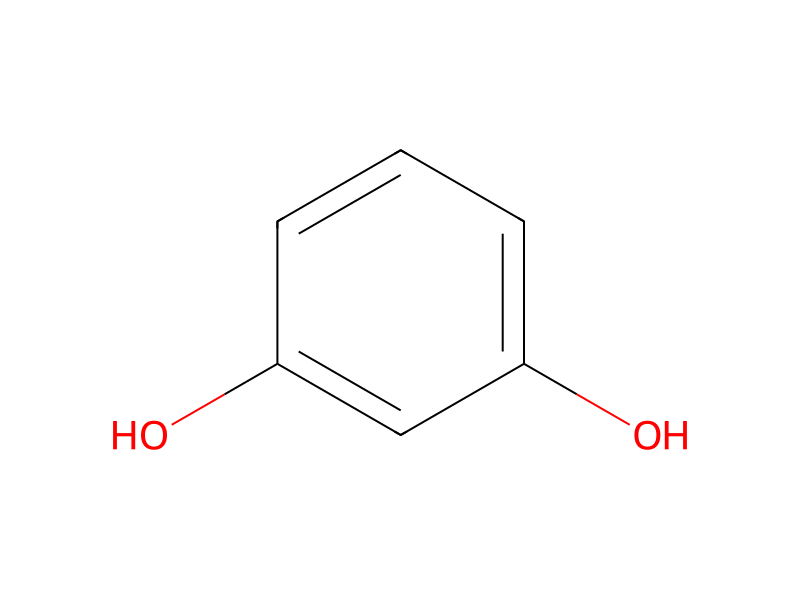

Product 1

Reagents, catalysts & solvents 1

Conditions
- Temperature
- 40 °C
Procedure
Into a 1-liter reaction kettle equipped with a stirrer, thermometer, reflux condenser and an addition funnel, 128.3 grams of phenol (1.35 mole), 21.3 grams of t-octylphenol (0.10 mole) and 1.0 gram of zinc acetate catalyst were charged and heated to 35-45° C. Then, 59.9 grams of an aqueous formaldehyde (first) solution (37.6 wt. %; 0.75 mole) were added slowly for a period of about 10-15 minutes. After the formaldehyde addition, the reactor contents were stirred under reflux for about 90-180 minutes. Then, 24.0 grams of formaldehyde solution (second) (37.6 wt. %; 0.30 mole) were added into the reactor for a period of 15-30 minutes at 85-95° C. The reactor contents were again heated to reflux for an additional period of 90-180 minutes. A distillation set up was made and the water distillate was collected until the temperature of the reactor reached 125-130° C. under atmospheric conditions. After this, once again the reactor contents were stirred under reflux for 60-120 minutes. The water present in the reactor was then removed first by atmospheric distillation to 150-155° C. and later by applying vacuum and holding it for 15 minutes at 155-160° C. and under 26-28 inches of Hg vacuum. After this distillation, vacuum was released and the reflux condenser was attached again. Resorcinol (51.1 grams; 0.464 mole) was then added into the reactor at 130-150° C. slowly with constant stirring. After this addition, 22.7 grams of an aqueous formaldehyde solution (third) (37.6 wt. %; 0.284 mole) was added for about 45-60 minutes under reflux. Following the third formaldehyde addition, the reactor contents were held at reflux for an additional 30 minutes. Atmospheric and vacuum distillations were carried out once again to remove distillate to obtain a modified phenolic novolak resin with a resorcinolic novolak, produced in-situ from the resorcinol-formaldehyde reaction, having a softening point of 112.4° C.
Workup
- customInto a 1-liter reaction kettle
- customequipped with a stirrer
- temperaturethermometer, reflux condenser and an addition funnel
- temperatureunder reflux for about 90-180 minutes
- temperatureThe reactor contents were again heated
- temperatureto reflux for an additional period of 90-180 minutes
- distillationA distillation
- distillationthe water distillate was collected until the temperature of the reactor
- customreached 125-130° C. under atmospheric conditions
- stirringAfter this, once again the reactor contents were stirred
- temperatureunder reflux for 60-120 minutes
- customThe water present in the reactor was then removed first by atmospheric distillation to 150-155° C.
- customfor 15 minutes
- customat 155-160° C.
- distillationAfter this distillation, vacuum
- additionwas added for about 45-60 minutes
- temperatureunder reflux
- temperatureat reflux for an additional 30 minutes
- customto remove distillate
- customto obtain a modified phenolic novolak resin with a resorcinolic novolak
Sources & evidence
- ORD record
- ord-9778c32848c6480cb8b4749ce3c8b67b
- Source dataset
- uspto-grants-2004_12
- Patent number
- US06828383B2
Reaction notes
Loading…