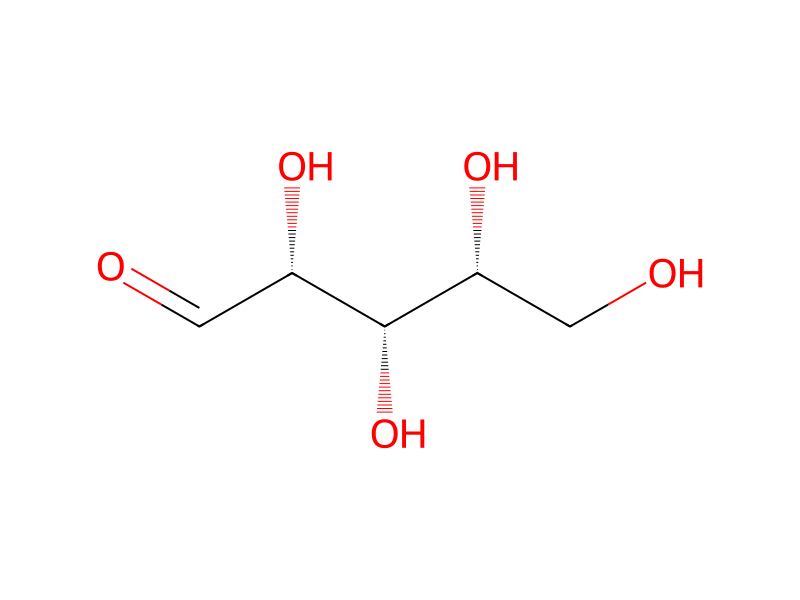
aldehydo-D-Xylose → Xylobiose
Reaction equation

C[O:2][C@H:3]1[C@H:8]([OH:9])[C@@H:7]([O:10][C@H:11]2[O:16][C:15](C(O)=O)=[CH:14][C@H:13]([OH:20])[C@H:12]2[OH:21])[C@H:6]([O:22]C)[O:5][CH2:4]1.[O:24]=C[C@@H]([C@H]([C@@H](CO)O)O)O>>[CH2:15]1[O:16][C@@H:11]([O:10][C@@H:7]([C@H:8]([OH:9])[C@@H:3]([OH:2])[CH:4]=[O:5])[CH2:6][OH:22])[C@H:12]([OH:21])[C@@H:13]([OH:20])[C@@H:14]1[OH:24]Participants


Procedure
The xylobiose or xylotriose liberated in the hydrolysis reaction was detected by developing the plate as follows: The plate was air-dried for appr. 10 minutes. After this the plate was sprayed with the developer (10% H2O, 10% conc. H2SO4, 80% ethanol and 0.2% 3.5-dihydroxytoluene, orcin: Merck 820933). The plate was dried (appr. 10 min on a paper) and developed by incubating it at 105-110° C. for 10 min. The xylobiose (and xylose, in the presence of β-xylosidase in the enzyme sample) formed could be detected as a coloured dot at the same distance from the starting line as the standard sugars (1-5 μl of 0.2% aqueous solution applied similarly to the hydrolysate). Thus the bond between hexenuronic acid and xylose was broken by hexenuronidase activity present in the enzyme sample, resulting in the release of free xylobiose.
Sources & evidence
- ORD record
- ord-82c28b9d6c234dc6abd5b582ef0f4d39
- Source dataset
- uspto-grants-2004_12
- Patent number
- US06830655B2
Reaction notes
Loading…