Methanol → Ethylene carbonate
Reaction equation

CO.[C:3]1(=[O:8])[O:7][CH2:6][CH2:5][O:4]1>C(O)CO>[C:3](=[O:8])([O:7][CH3:6])[O:4][CH3:5].[C:3]1(=[O:8])[O:7][CH2:6][CH2:5][O:4]1Participants
Reactant 2


Product 2
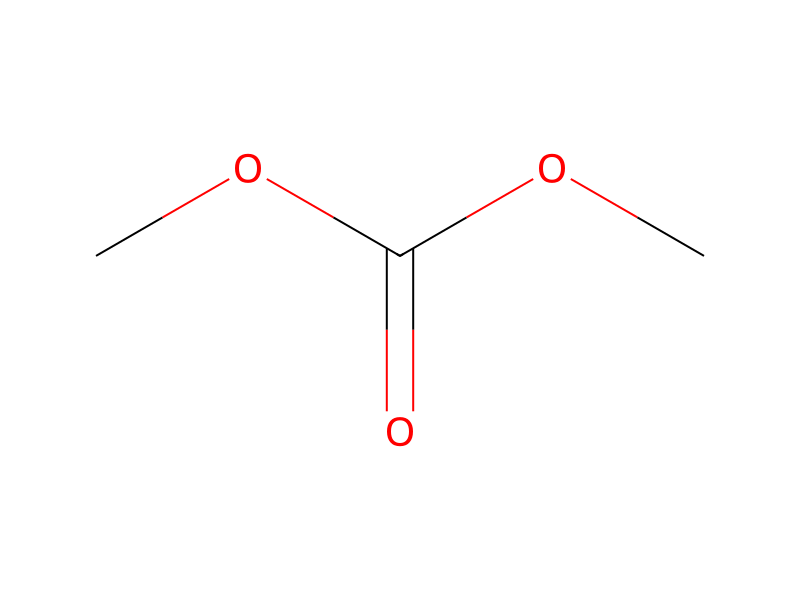
Reagents, catalysts & solvents 1

Procedure
More specifically, methanol and ethylene carbonate are fed into the transesterification reactor "A" in FIG. 1 in streams adjusted to maintain a mole ratio of methanol to ethylene carbonate of between 1:2 and 1:5. The reactor is maintained at a temperature of from 0° C. to 150° C. and a pressure of 0-5000 psig, and the methanol and ethylene carbonate are passed over a heterogeneous catalyst, producing as effluents methanol, dimethyl carbonate, ethylene glycol and ethylene carbonate. These effluents are channeled to a distillation tower, designated "B", where the methanol and dimethyl carbonate are removed as "overhead". This "overhead" fraction is sent to a second distillation tower, designated "C", wherein the overhead is distilled at about 10 atm to recover pure dimethyl carbonate as a "bottoms" product and methanol as an "overhead" product. The methanol is recycled to the first reactor "A", and the dimethyl carbonate is sent to storage. The bottoms from Tower "B" are sent to a fourth tower, designed as "D", and distilled at about 100 mm Hg wherein an overhead comprising an azeotrope of ethylene carbonate and ethylene glycol is produced and passed over a second catalyst bed, which catalyzes the addition of stoichiometric amounts of water to the ethylene carbonate in the azeotrope. This bed, designated as reactor "E" produces substantial quantities of ethylene glycol. The bottoms from "D", largely ethylene carbonate, are recycled to reactor "A".
Workup
- temperatureThe reactor is maintained at a temperature of from 0° C. to 150° C.
Sources & evidence
- ORD record
- ord-954a646f5e954c58ba99c4c2de179a1f
- Source dataset
- uspto-grants-1987_09
- Patent number
- US04691041
Reaction notes
Loading…