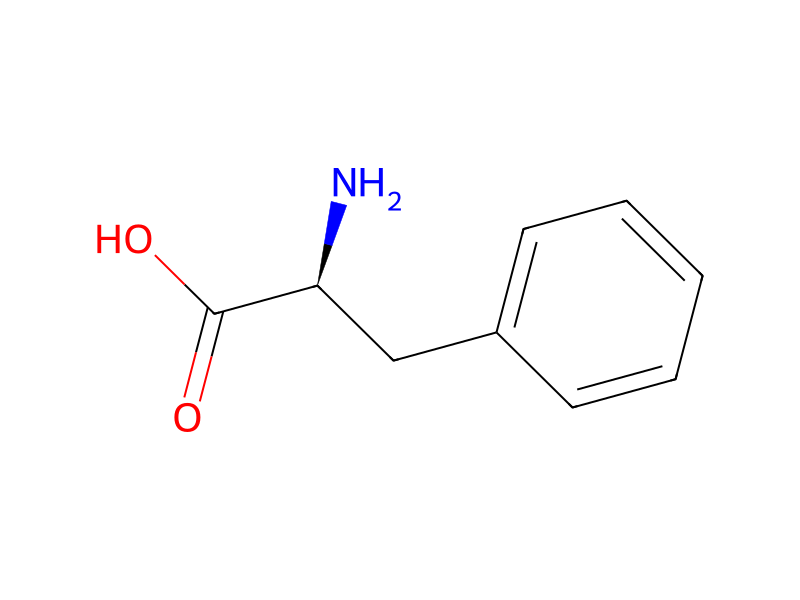
L-Phenylalanine → Benzoyl-L-phenylalanine
Reaction equation

[OH-:1].[Na+].[NH2:3][C@H:4]([C:12]([OH:14])=[O:13])[CH2:5][C:6]1[CH:11]=[CH:10][CH:9]=[CH:8][CH:7]=1.N[C@@H](C(O)=O)[CH2:17][C:18]1[CH:23]=[CH:22][CH:21]=[CH:20][CH:19]=1>>[C:17]([NH:3][C@H:4]([C:12]([OH:14])=[O:13])[CH2:5][C:6]1[CH:11]=[CH:10][CH:9]=[CH:8][CH:7]=1)(=[O:1])[C:18]1[CH:23]=[CH:22][CH:21]=[CH:20][CH:19]=1Participants
4



Procedure
If a NaOH solution is used in place of the Na2CO3 in Example 1 and substantially following the procedure set forth in Carter, H. E. et al., J. Biol. Chem. 138, 627 (1941), optical activity is maintained. That is if L-Phe or D-Phe is the starting material, Nα -benzoyl-L-Phe or Nα -benzoyl-D-Phe respectively is produced.
Workup
- temperature138, 627 (1941), optical activity is maintained
- customrespectively is produced
Sources & evidence
- ORD record
- ord-4e05cf3c330d489a92dc5a90005e187f
- Source dataset
- uspto-grants-1987_09
- Patent number
- US04692458
Reaction notes
Loading…