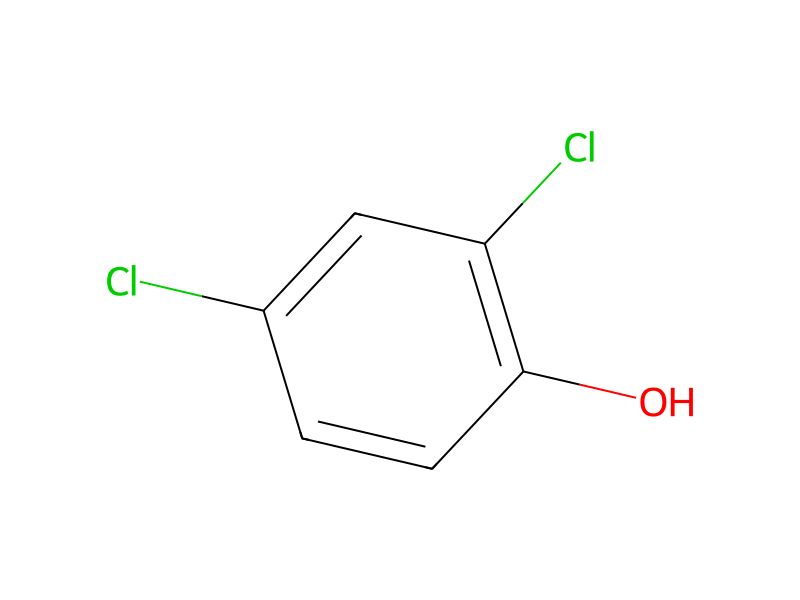
2,4-Dichlorophenol → Bis(2,4-dichlorophenyl) phosphorochloridate
Reaction equation

[Cl:1][C:2]1[CH:7]=[C:6]([Cl:8])[CH:5]=[CH:4][C:3]=1[OH:9].[P:10]([Cl:14])(Cl)(Cl)=[O:11]>>[Cl:1][C:2]1[CH:7]=[C:6]([Cl:8])[CH:5]=[CH:4][C:3]=1[O:9][P:10]([Cl:14])(=[O:11])[O:9][C:3]1[CH:4]=[CH:5][C:6]([Cl:8])=[CH:7][C:2]=1[Cl:1]Participants


Procedure
The title compound was prepared by the general method of Example 1 with the following modifications. (1) The molar ratio of 2,4-dichlorophenol to phosphorus oxychloride was increased from 1.33 to 1.85 by using 189.99 g (1.165 mole) of 2,4-dichlorophenol and 96.60 g (0.63 mole) of phosphorus oxychloride. (2) The reaction time at 120° was increased to about 24 hours. (3) The product was crystallized using a larger quantity of hexane (570 ml, or 3 ml per gram of starting 2,4-dichlorophenol) at -15°. Analysis by GLPC indicated 82% purity (by weight) of bis(2,4-dichlorophenyl)phosphorochloridate, with contamination by a trace of 2,4-dichlorophenyl phosphorodichloridate and 18% (by weight) of tris(2,4-dichlorophenyl)phosphate. The yield of the bis(2,4-dichlorophenyl)phosphorochloridate when corrected for purity was 125 g (53%). Subsequent reactions were unaffected by the presence of the tris(2,4-dichlorophenyl)phosphate, as illustrated by Examples 3 and 4.
Workup
- custom(3) The product was crystallized
- customat -15°
Sources & evidence
- ORD record
- ord-80dea17936d34f6ca2546d482e195e79
- Source dataset
- uspto-grants-1989_07
- Patent number
- US04845261
Reaction notes
Loading…