Benzyl Alcohol → Benzyl 6-bromohexanoate
Reaction equation

[Br:1][CH2:2][CH2:3][CH2:4][CH2:5][CH2:6][C:7]([OH:9])=[O:8].[CH2:10](O)[C:11]1[CH:16]=[CH:15][CH:14]=[CH:13][CH:12]=1.C1(N=C=NC2CCCCC2)CCCCC1>CN(C)C1C=CN=CC=1.ClCCl>[CH2:10]([O:8][C:7](=[O:9])[CH2:6][CH2:5][CH2:4][CH2:3][CH2:2][Br:1])[C:11]1[CH:16]=[CH:15][CH:14]=[CH:13][CH:12]=1Participants
6
Reactant 3


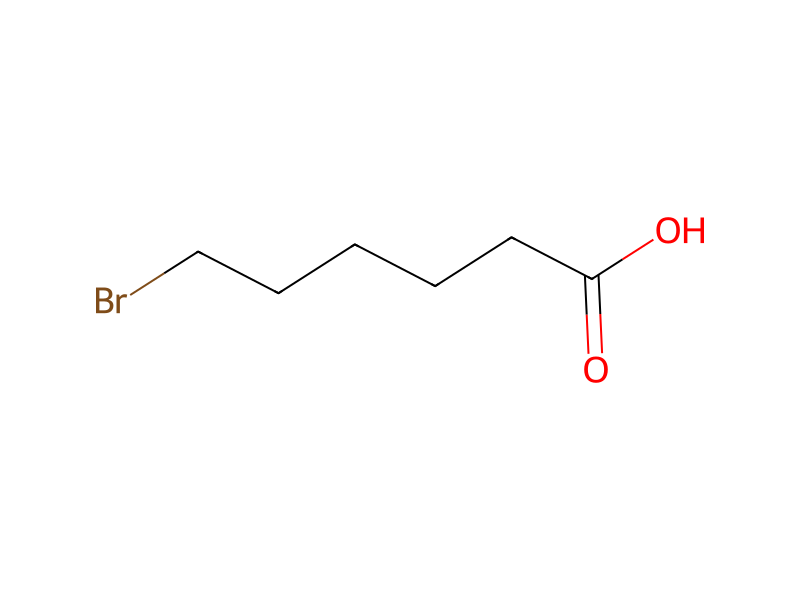
Product 1

Reagents, catalysts & solvents 2


Procedure
A mixture of 6-bromo-hexanoic acid (0.10 mol), benzyl alcohol (0.10 mol), 4-dimethylaminopyridine (1.78·10−2 mol) and dichloromethane (600 ml) is stirred and kept at 0° C. with an ice bath, then added with N,N′-dicyclohexylcarbodiimide (0.13 mol) and left to react for 16 hours. At the end of the reaction, the solution is filtered and the precipitate is discarded, whilst the solution is repeatedly washed with H2O, discarding the precipitate possibly formed. The organic layers are pooled and washed again with a saturated solution of NaHCO3, a solution of HCl 0.1 M and then with water. The solution is dried with MgSO4, filtered, and the solvent is removed by vacuum evaporation.
Workup
- customkept at 0° C. with an ice bath
- waitleft
- customto react for 16 hours
- customAt the end of the reaction
- filtrationthe solution is filtered
- washis repeatedly washed with H2O
- custompossibly formed
- washwashed again with a saturated solution of NaHCO3
- dry with materialThe solution is dried with MgSO4
- filtrationfiltered
- customthe solvent is removed by vacuum evaporation
Sources & evidence
- ORD record
- ord-975ff2f5a3b74265a2f037b9274f3905
- Source dataset
- uspto-grants-2010_07
- Patent number
- US07750157B2
Reaction notes
Loading…