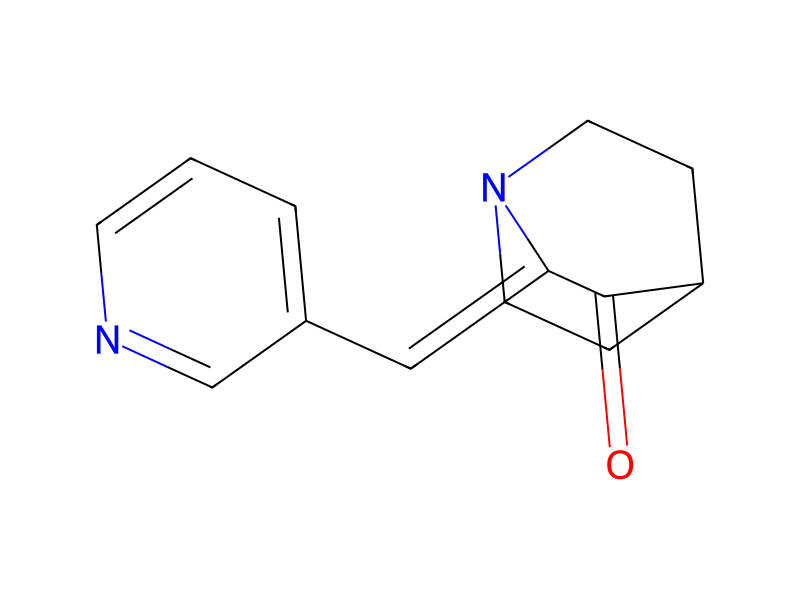
Water → 2-(Pyridin-3-ylmethylidene)-1-azabicyclo[2.2.2]octan-3-one
Reaction equation

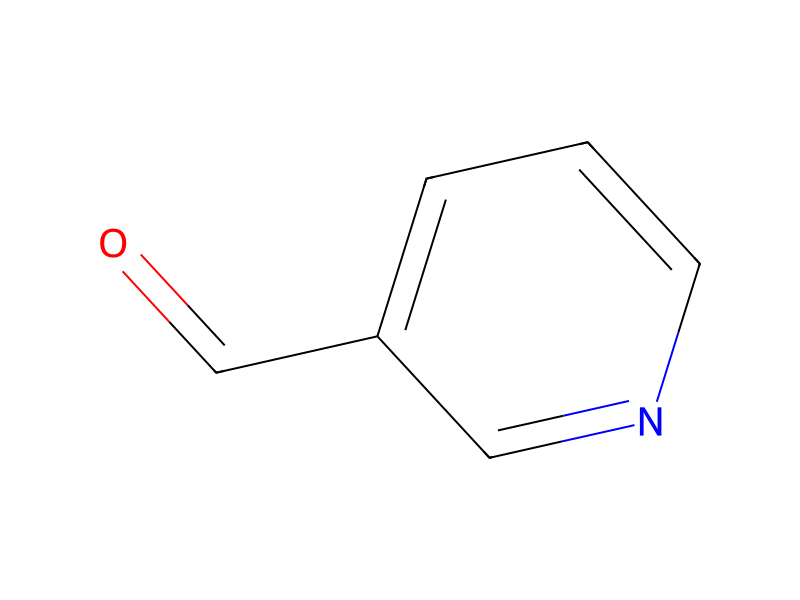
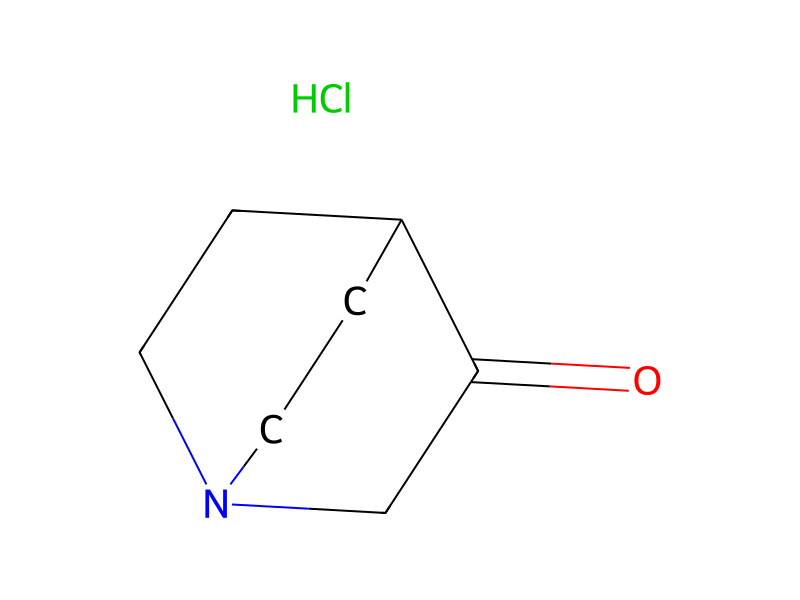
[OH-].[K+].Cl.[N:4]12[CH2:11][CH2:10][CH:7]([CH2:8][CH2:9]1)[C:6](=[O:12])[CH2:5]2.[N:13]1[CH:18]=[CH:17][CH:16]=[C:15]([CH:19]=O)[CH:14]=1.O>CO>[N:13]1[CH:18]=[CH:17][CH:16]=[C:15]([CH:19]=[C:5]2[C:6](=[O:12])[CH:7]3[CH2:10][CH2:11][N:4]2[CH2:9][CH2:8]3)[CH:14]=1Participants



Procedure
Potassium hydroxide (56 g, 0.54 mole) was dissolved in methanol (420 mL). 3-Quinuclidinone hydrochloride (75 g, 0.49 mole) was added and the mixture was stirred for 30 min at ambient temperature. 3-Pyridinecarboxaldehyde (58 g, 0.54 mole) was added and the mixture stirred for 16 h at ambient temperature. The reaction mixture became yellow during this period, with solids caking on the walls of the flask. The solids were scraped from the walls and the chunks broken up. With rapid stirring, water (390 mL) was added. When the solids dissolved, the mixture was cooled at 4° C. overnight. The crystals were collected by filtration, washed with water, and air dried to obtain 80 g of yellow solid. A second crop (8 g) was obtained by concentration of the filtrate to ˜10% of its former volume and cooling at 4° C. overnight. Both crops were sufficiently pure for further transformation (88 g, 82%).
Workup
- stirringthe mixture stirred for 16 h at ambient temperature
- waitThe reaction mixture became yellow during this period, with solids
- dissolutionWhen the solids dissolved
- temperaturethe mixture was cooled at 4° C. overnight
- filtrationThe crystals were collected by filtration
- washwashed with water, and air
- customdried
Sources & evidence
- ORD record
- ord-577506d715954f6081025dca3e96bf7a
- Source dataset
- uspto-grants-2010_07
- Patent number
- US07754189B2
Reaction notes
Loading…