Sucrose → Octyl (3R)-4-chloro-3-hydroxybutanoate
Reaction equation

C(O)[C@H]1O[C@H](O[C@]2(CO)O[C@H](CO)[C@@H](O)[C@@H]2O)[C@H](O)[C@@H](O)[C@@H]1O.[CH2:24]([O:32][C:33](=[O:39])[CH2:34][C:35]([CH2:37][Cl:38])=[O:36])[CH2:25][CH2:26][CH2:27][CH2:28][CH2:29][CH2:30][CH3:31]>O>[CH2:24]([O:32][C:33](=[O:39])[CH2:34][C@@H:35]([OH:36])[CH2:37][Cl:38])[CH2:25][CH2:26][CH2:27][CH2:28][CH2:29][CH2:30][CH3:31]Participants
Reactant 2
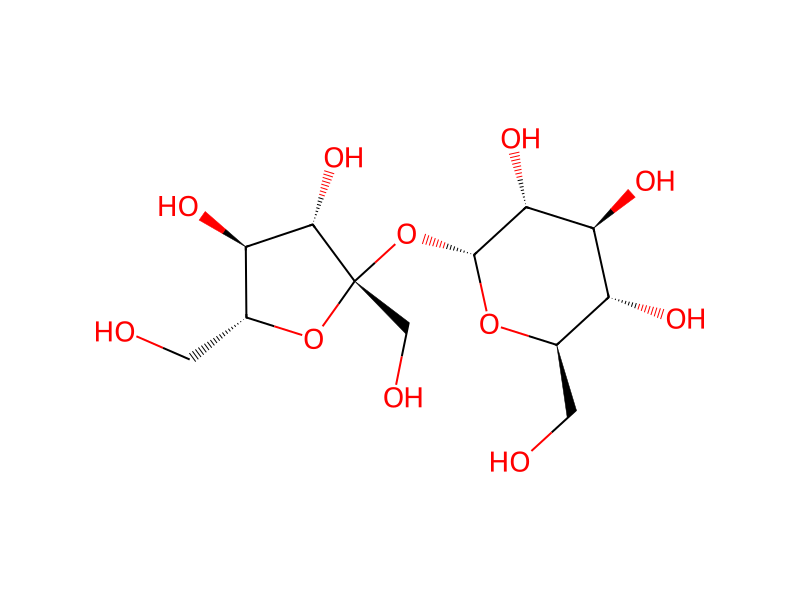

Product 1

Reagents, catalysts & solvents 1

Procedure
One hundred grams of commercial fresh Baker's yeast Saccharomyces cerevisiae (Red Star) was suspended in 250 ml of tap water to which was added 10 g of sucrose and 3.6 g of γ-chloroacetoacetic octyl ester. After the contents were incubated at 25° C. on a rotary shaker (250 cycles/minute--2" radius) for 24 hours, an additional 10 g of sucrose was added to the flask and the reaction was allowed to proceed for another 24 hours. The cells were then removed by filtration through a pad of celite. The cells were washed with water and ethyl acetate. The washings were combined with the filtrate and exhaustively extracted with ethyl acetate. The ethyl acetate layer was dried over MgSO4 and evaporated to give an oily residue, which was chromatographed over a silica gel column to yield 2.52 g of 4-chloro-3(R)-hydroxybutyric acid octyl ester, as a low melting solid; [α]D23 +13.2° (c, 4.0, CHCl3).
Workup
- waitto proceed for another 24 hours
- customThe cells were then removed by filtration through a pad of celite
- washThe cells were washed with water and ethyl acetate
- extractionexhaustively extracted with ethyl acetate
- dry with materialThe ethyl acetate layer was dried over MgSO4
- customevaporated
- customto give an oily residue, which
- customwas chromatographed over a silica gel column
Sources & evidence
- ORD record
- ord-bccd6a6197b9474b8e2c172f50dc2ddc
- Source dataset
- uspto-grants-1987_02
- Patent number
- US04642290
Reaction notes
Loading…