Phloroglucinol → Trinitrophloroglucinol
Reaction equation

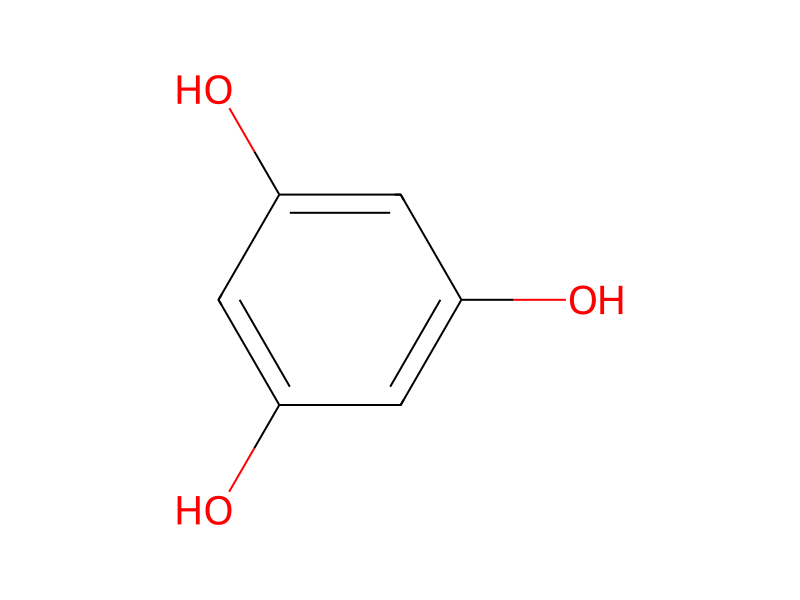
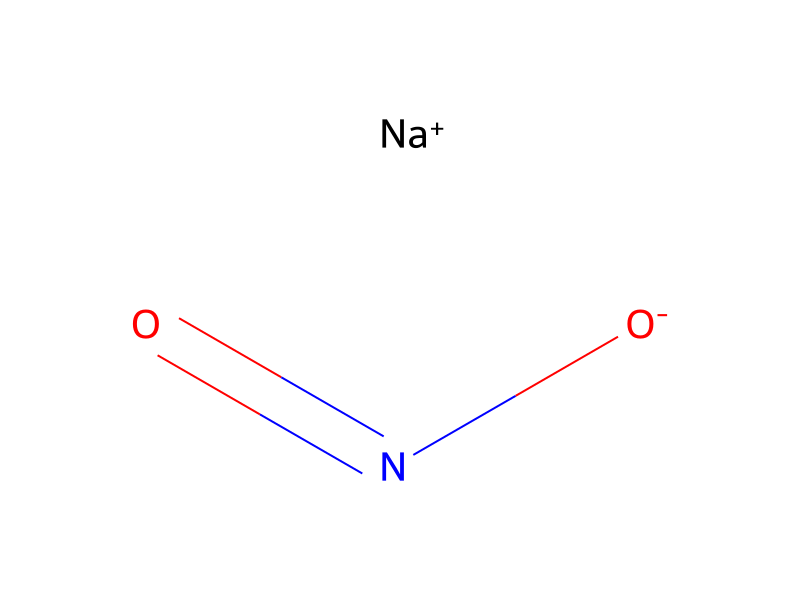
C1(N)C([N+:7]([O-:9])=[O:8])=C(N)C([N+]([O-])=O)=C(N)C=1[N+]([O-])=O.[C:19]1([CH:27]=[C:25]([OH:26])[CH:24]=[C:22]([OH:23])[CH:21]=1)[OH:20].[N:28]([O-:30])=[O:29].[Na+].[N+:32]([O-])([OH:34])=[O:33]>>[N+:7]([C:27]1[C:19]([OH:20])=[C:21]([N+:28]([O-:30])=[O:29])[C:22]([OH:23])=[C:24]([N+:32]([O-:34])=[O:33])[C:25]=1[OH:26])([O-:9])=[O:8]Participants



Procedure
One method of synthesizing TATB from phloroglucinol is described in GB 2355715. Phloroglucinol, also known as 1,3,5-trihydroxybenzene, is nitrated using sodium nitrite and nitric acid, forming trinitrophloroglucinol (“TNPG”), which is also known as 1,3,5-trihydroxy-2,4,6-trinitrobenzene. The nitric acid is added sequentially or in multiple additions. When cooled, a solid is produced, which is filtered, washed with 3 M hydrochloric acid (“HCl”), and dried, yielding a solid product that is a monohydrate of TNPG. The monohydrate of TNPG is a free-flowing solid. The TNPG is alkoxylated using a trialkyl orthoformate, such as trimethyl orthoformate, forming 1,3,5-trimethoxy-2,4,6-trinitrobenzene. Methanol and methyl formate are also formed and are removed by distillation. The solution of 1,3,5-trimethoxy-2,4,6-trinitrobenzene is concentrated, yielding 1,3,5-trimethoxy-2,4,6-trinitrobenzene as a solid, which is recrystallized from ethanol. The purified 1,3,5-trimethoxy-2,4,6-trinitrobenzene is then aminated using liquid ammonia or gaseous ammonia, filtered, washed with N-methylpyrrolidinone and methanol, and dried, yielding crystals of the TATB. To conduct the amination reaction, a solution of the 1,3,5-trimethoxy-2,4,6-trinitrobenzene is cooled to −10° C. and ammonia gas is introduced. If liquid ammonia is used, the animation reaction is conducted at room temperature and a pressure of 8-9 bar, or at atmospheric pressure and −33° C. If gaseous ammonia is used, the animation reaction is conducted at atmospheric pressure or at a pressure of 8-9 bar. At higher temperatures, the method is described as being less energy efficient. The TATB synthesis utilizes multiple drying and isolation acts to produce solid products of TNPG, TETNB, and TATB.
Sources & evidence
- ORD record
- ord-0e5f64deeebd4bb091dbd87518c27719
- Source dataset
- uspto-grants-2010_07
- Patent number
- US07763753B1
Reaction notes
Loading…