Durene → Durene
Reaction equation

COC.[CH2:4](O)[CH3:5].COC.[C:10]1([C:12](=[CH:14][C:15](=[C:17]([CH:19]=1)[CH3:18])[CH3:16])[CH3:13])[CH3:11]>CO>[CH3:18][C:17]1[CH:19]=[CH:10][C:12]([CH3:13])=[C:14]([CH3:15])[C:4]=1[CH3:5].[C:10]1([C:12](=[CH:14][C:15](=[C:17]([CH:19]=1)[CH3:18])[CH3:16])[CH3:13])[CH3:11]Participants
Reactant 3
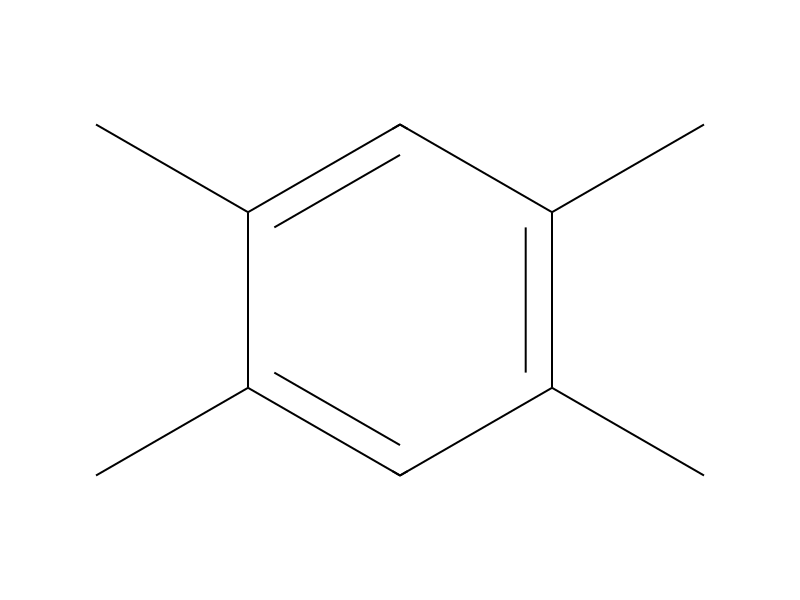


Product 2

Reagents, catalysts & solvents 1

Procedure
The entire reactor system is operated at elevated pressure, 50 to 100 atmospheres, with modest pressure decreases due to pressure drop as a result of flow through the catalysts, pipes, and heat exchangers. This pressure drop is maintained at modest values to economize on the size and cost of the recycle compressor. The high pressure enhances the conversion of synthesis gas to the methanol intermediate in the first stage, has no effect in the conversion of methanol to the intermediate dimethylether. However, it is known in the art (Yurchak) that the conversion of ethanol/dimethylether to gasoline in the third stage also produces heavy gasoline, principally ≧C8 aromatics, such as tri-methyl benzenes, tetramethyl benzenes, and durene. In particular, highly undesirable tetra-methyl benzene and durene are produced which have high melting points (79° C. or greater) and limited solubility in the hydrocarbon mixture even at room temperature. Their viscometric behavior cannot be tolerated in an all-weather commercial fuel. In the present process, however, this intermediate product, containing heavy gasoline, is converted to desirable hydrocarbon products in the fourth stage by significantly reducing the trimethylbenzene and tetramethylbenzene and durene isomer groups via hydrotreating and producing desirable fuel compounds such as toluene, xylenes and C4 to C8 hydrobarbons, principally C5 to C7 hydrocarbons. This conversion is obtained by the proper choice of catalyst, space velocity and temperature of the reactor. The presence of heavy gasoline in the product produced from the third reaction is undesirable because it increases the freezing temperature of the fuel which renders the fuel unusable in cold weather. The fourth reactor converts the heavy gasoline to toluene, xylenes, and/or C4 to C8 hydrocarbon, which lowers the freezing point of the fuel product. Preferably, the fuel product coming out of the fourth reactor has a freezing point of less than about −5° C., preferably about −15 to about −20° C., while the product coming out of the third reactor has a freezing point of about 30-50° C.
Workup
- customa result of flow through the catalysts, pipes
- temperatureheat exchangers
- temperatureThis pressure drop is maintained at modest values
Sources & evidence
- ORD record
- ord-fb2f099aa108475fbd7d44cd85e56696
- Source dataset
- uspto-grants-2014_04
- Patent number
- US08686206B2
Reaction notes
Loading…