
Durene
Completing data — refresh the page later to see the latest
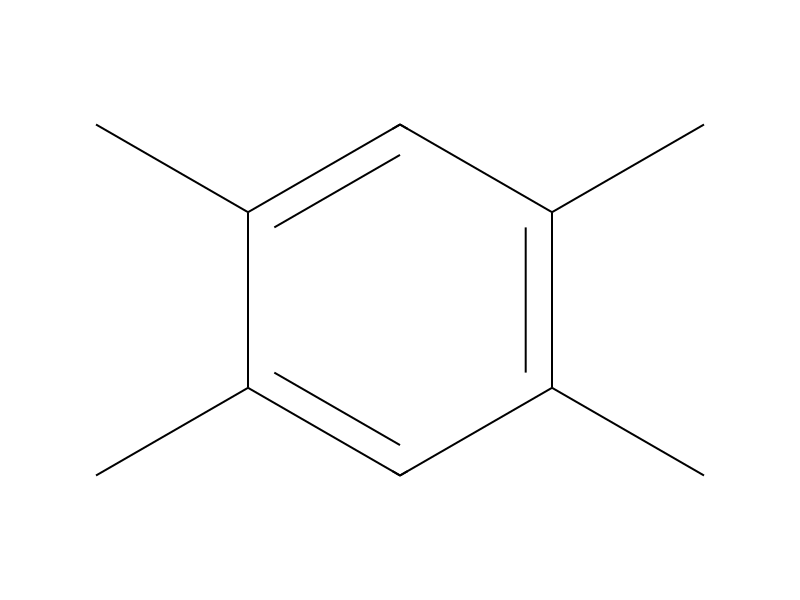
Basic information
- CAS
95-93-2- Standard SMILES
Cc1cc(C)c(C)cc1C- InChIKey
SQNZJJAZBFDUTD-UHFFFAOYSA-N- Molecular formula
- C10H14
- Average molar mass
- 134.22 g/mol
- Monoisotopic mass
- 134.10955045
Overview
1,2,4,5-tetramethylbenzene appears as colorless crystals with a camphor-like odor. (NTP, 1992)
Names & identifiers
- Preferred name
- Durene
- IUPAC
- 1,2,4,5-tetramethylbenzene
- English name
- 1,2,4,5-Tetramethylbenzene
- Molecular formula
- C10H14
- Molecular weight
- 134.22
Names & synonyms
1,2,4,5-TETRAMETHYLBENZENEDurene95-93-2DurolBenzene, 1,2,4,5-tetramethyl-p-Xylene, 2,5-dimethyl-DTXSID1029124181426CFYBNSC-6770DTXCID309124CHEBI:38978RefChem:590468
Show more names
1,2,4,5-TETRAMETHYLBENZENE (DURENE)1,2,4,5-TetramethyL1,2,4,5-TERAMETHYLBENZENEbenzene,1,2,4,5-tetramethyl-Durol[R]1.2.4.5-TetraMThymol Impurity?401,2,4,5-Tetramethylb
202-465-7MFCD000085281,2,4,5-tetramethyl-benzeneCAS-95-93-2NSC 6770EINECS 202-465-7DurenUNII-181426CFYB
Database identifiers
- CAS
95-93-2- PubChem CID
- 7269
- DTXSID
DTXSID1029124- ChEMBL
CHEMBL1797134- ChEBI
CHEBI:38978- UNII
- 181426CFYB
- EC Number
- 202-465-7
- Nikkaji
- J4.714G
Properties
Computed structural propertiesFilling in
- XLogP
- 4
- Topological polar surface area
- 0 Ų
- Hydrogen bond donors
- 0
- Hydrogen bond acceptors
- 0
- Rotatable bonds
- 0
- Heavy atoms
- 10
- Formal charge
- 0
- Complexity
- 80.6
Experimental & physicochemical properties
Chemical ClassesOther Classes -> Aromatic Hydrocarbons
SpringerMaterials Properties13C nuclear magnetic resonance spectrum
Density
0.8875 at 68 °F (NTP, 1992) - Less dense than water; will float
0.838 @ 81°C
Flash Point
130 °F (NFPA, 2010)
74 °C
Boiling Point
386.2 °F at 760 mmHg (NTP, 1992)
196 °C @760 [mm Hg]
Melting Point174.6 °F (NTP, 1992)
Physical Description
1,2,4,5-tetramethylbenzene appears as colorless crystals with a camphor-like odor. (NTP, 1992)
Colorless solid; [CAMEO]
Physicochemical properties
- Melting point
- 78 °C · 78 °C
- Boiling point
- 196 · 196-197 °C
- Density
- 0.838 g/mL · 0.838 g/mL at 25 °C(lit.)
- vapor density
- 4.6 · 4.6 (vs air)
- vapor pressure
- 160 mm · 160 mm Hg ( 140 °C)
- refractive index
- 1.5093 · 1.5093
- Flash point
- 165 °F · 165 °F
- storage temp.
- Flammables area
- solubility
- 0.00348 g/l · 0.00348g/l
- form
- crystals
- color
- White to Almost white
- Specific Gravity
- 0.838 · 0.838
- Odor
- rancid sweet
- Water Solubility
- insoluble
- Specific Heat Capacity
- 1.6 J/ · Cp(crystal): 1.6 J/(g·K), at 25℃
- Merck
- 14 · 14,3468
- BRN
- 1903393 · 1903393
- Henry's Law Constant
- 2.49 at · 2.49 at 25 °C (approximate - calculated from water solubility and vapor pressure)
- InChI
- 1S/C10H14/c1-7-5-9(3)10(4)6-8(7)2/h5-6H,1-4H3
- InChIKey
- SQNZJJAZBFDUTD-UHFFFAOYSA-N
- SMILES
- Cc1cc(C)c(C)cc1C
- LogP
- 4 · 4.000
- CAS DataBase Reference
- 95 · 95-93-2(CAS DataBase Reference)
- FDA UNII
- 181426 CFYB · 181426CFYB
- NIST Chemistry Reference
- 1 · Benzene, 1,2,4,5-tetramethyl-(95-93-2)
- EPA Substance Registry System
- 1 · 1,2,4,5-Tetramethylbenzene (95-93-2)
- UNSPSC Code
- 41116107 · 41116107
- NACRES
- 24 · NA.24
- Symbol(GHS)
- 2 · GHS02
- Signal word
- Danger
- Hazard statements
- 402 · H402-H228
- Precautionary statements
- 501 · P501-P273-P240-P210-P241-P280-P370+P378
- PPE
- 3 · Eyeshields, Gloves, type P3 (EN 143) respirator cartridges
- Hazard Codes
- F,N
- Risk Statements
- 11 · 11-53-50
- Safety Statements
- 16 · 16-61
- RIDADR
- 1325 · UN 1325 4.1/PG 2
- WGK Germany
- 1 · 1
- RTECS
- 500000 · DC0500000
- TSCA
- TSCA listed
- HazardClass
- 4.1 · 4.1
- PackingGroup
- III
- HS Code
- 29029080 · 29029080
- Storage Class
- 4.1 B · 4.1B - Flammable solid hazardous materials
- Hazard Classifications
- 1 Aquatic · Aquatic Acute 1Aquatic Chronic 1Flam. Sol. 1
- Toxicity
- 50 orally · LD50 orally in Rabbit: 6700 mg/kg
- Limited Quantities
- 1 Kg · 1.0 Kg (2.2 lbs)
- Excepted Quantities
- Max Inner Pack (30g or 30ml) and Max Outer Pack (500g or 500ml)
Safety & regulation
Safety information is for reference only and does not replace the supplier’s Safety Data Sheet (SDS), applicable regulations, or professional assessment.
GHS classification
GHS Classification
This chemical does not meet GHS hazard criteria for 8.1% (24 of 298) of reports.
Danger
H228 (89.6%): Flammable solid [Danger Flammable solids]
P210, P240, P241, P273, P280, P370+P378, and P501 (click each P-code to see the statement)
Aggregated GHS information provided per 298 reports by companies from 7 notifications to the ECHA C&L Inventory. Each notification may be associated with multiple companies.
Hazard information
Regulatory Information
Chemical: Benzene, 1,2,4,5-tetramethyl-
Benzene, 1,2,4,5-tetramethyl-: Does not have an individual approval but may be used under an appropriate group standard
DOT LabelFlammable Solid
Fire HazardsExcerpt from ERG Guide 133 [Flammable Solids]:
Health HazardsExcerpt from ERG Guide 133 [Flammable Solids]:
Reactive GroupHydrocarbons, Aromatic
Reactivity Profile
Vigorous reactions, sometimes amounting to explosions, can result from the contact between aromatic hydrocarbons, such as 1,2,4,5-TETRAMETHYLBENZENE, and strong oxidizing agents. They can react exothermically with bases and with diazo compounds. Substitution at the benzene nucleus occurs by halogenation (acid catalyst), nitration, sulfonation, and the Friedel-Crafts reaction.
Air and Water ReactionsInsoluble in water.
Hazard Classes and CategoriesFlam. Sol. 1 (89.6%)
Safety & protection
Fire FightingTo extinguish a fire involving this chemical you may use a dry chemical, carbon dioxide, foam or halon extinguisher; a water spray may also be used. (NTP, 1992)
First Aid
EYES: First check the victim for contact lenses and remove if present. Flush victim's eyes with water or normal saline solution for 20 to 30 minutes while simultaneously calling a hospital or poison control center. Do not put any ointments, oils, or medication in the victim's eyes without specific instructions from a physician. IMMEDIATELY transport the victim after flushing eyes to a hospital even if no symptoms (such as redness or irritation) develop.
Nonfire Spill Response
SMALL SPILLS AND LEAKAGE: If you spill this chemical, use absorbent paper to pick up all liquid spill material. Your contaminated clothing and absorbent paper should be sealed in a vapor-tight plastic bag for eventual disposal. Solvent wash all contaminated surfaces with alcohol followed by washing with a strong soap and water solution. Do not reenter the contaminated area until the Safety Officer (or other responsible person) has verified that the area has been properly cleaned.
Isolation and EvacuationExcerpt from ERG Guide 133 [Flammable Solids]:
Protective Action Criteria (PAC)
21 [mg/m3]
230 [mg/m3]
1400 [mg/m3]
Personal Protective Equipment (PPE)
RECOMMENDED RESPIRATOR: Where the neat test chemical is weighed and diluted, wear a NIOSH-approved half face respirator equipped with an organic vapor/acid gas cartridge (specific for organic vapors, HCl, acid gas and SO2) with a dust/mist filter.
Safety data
- PPE
- Eyeshields, Gloves, type P3 (EN 143) respirator cartridges
- wgk
- 1
- tsca
- TSCA listed
- rtecs
- DC0500000
- ridadr
- UN 1325 4.1/PG 2
- hs_code
- 29029080
- Toxicity
- LD50 orally in Rabbit: 6700 mg/kg
- risk_code
- 11-53-50
- Signal word
- Danger
- Symbol(GHS)
- GHS02
- hazard_code
- F,N
- safety_code
- 16-61
- hazard_class
- 4.1
- Storage Class
- 4.1B - Flammable solid hazardous materials
- packing_group
- III
- Hazard statements
- H402-H228
- Limited Quantities
- 1.0 Kg (2.2 lbs)
- Excepted Quantities
- Max Inner Pack (30g or 30ml) and Max Outer Pack (500g or 500ml)
- Hazard Classifications
- Aquatic Acute 1Aquatic Chronic 1Flam. Sol. 1
- Precautionary statements
- P501-P273-P240-P210-P241-P280-P370+P378
Chemistry & industry
Uses & manufacturing
UsesOccurs in coal tar; [Merck Index]
General Manufacturing InformationBenzene, 1,2,4,5-tetramethyl-: ACTIVE
Applications
UsesPlasticizers; polymers; fibers; organic synthesis.
Uses1,2,4,5-Tetramethylbenzene is used in method for reducing odor in room in remodeling work by removing causative substances.
General DescriptionColorless crystals with a camphor-like odor.
Upstream & downstream products
Upstream raw materials
Downstream products
Additional notes
DefinitionChEBI: Durene is a tetramethylbenzene carrying methyl groups at positions 1, 2, 4 and 5.
Related reactions
16 records


Compound notes
Loading…