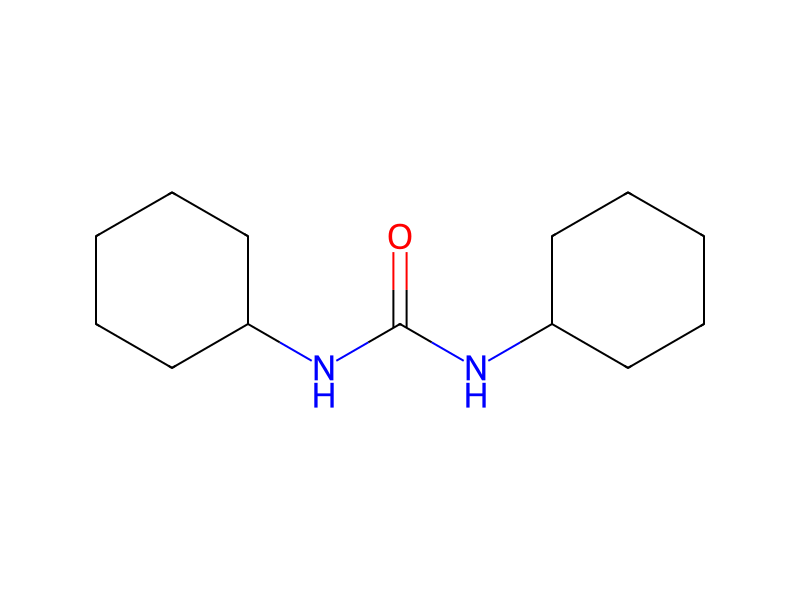
Dicyclohexylcarbodiimide → N,N'-Dicyclohexylurea
Reaction equation

[C:1]([OH:6])(=[O:5])[CH2:2][CH:3]=[CH2:4].[CH2:7]1[CH2:12][CH2:11][CH:10]([N:13]=[C:14]=[N:15][CH:16]2[CH2:21][CH2:20][CH2:19][CH2:18][CH2:17]2)[CH2:9][CH2:8]1>C1COCC1>[C:1]([OH:6])(=[O:5])[CH2:2][CH:3]=[CH2:4].[C:14]([NH:13][CH:10]1[CH2:9][CH2:8][CH2:7][CH2:12][CH2:11]1)([NH:15][CH:16]1[CH2:21][CH2:20][CH2:19][CH2:18][CH2:17]1)=[O:5]Participants
Reactant 2


Product 2
Reagents, catalysts & solvents 1

Procedure
NHS ester of 3-butenoic acid was synthesized based following literature procedure.32 3-butenoic acid (1.0 g, 1.2 mmol) and NHS (1.47 g, 1.28 mmol) were dissolved in THF (30 ml). The solution was cooled in an ice bath and N,N′-dicyclohyxylcarbodiimide (DCC, 2.4 g, 1.2 mmol) was added under stirring. A white precipitate, dicyclohexylurea (DCU), formed after ˜5 min and the mixture was stirred for 1 hour at 0° C. The reaction proceeded at 4° C. overnight without any agitation. DCU was then removed by filtration. The filtrate was concentrated to give a viscous oil containing some residual DCU. The crude product was re-dissolved in a small volume of THF and then filtered. This procedure was repeated until a clear THF solution was obtained. The solvent was removed and the product was then washed with hexane. Residual solvents were removed under vacuum until a constant weight was obtained. 1H-NMR (500 MHz, CDCl3, δ ppm): 2.64, 2.90, 5.21, 5.24, 5.94.
Workup
- temperatureThe solution was cooled in an ice bath
Sources & evidence
- ORD record
- ord-ad49e4f0efaf4579b65d4992bcb3fc3e
- Source dataset
- uspto-grants-2014_04
- Patent number
- US08691204B2
Reaction notes
Loading…