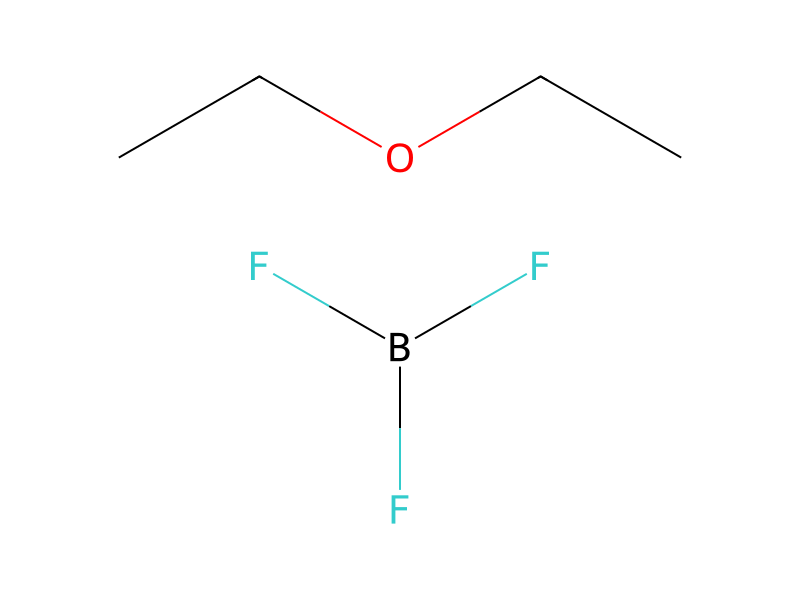
Boron trifluoride etherate → 1-Benzyl 4-ethyl 5-oxoazepane-1,4-dicarboxylate
Reaction equation

[CH2:1]1[N:7]([C:8]([O:10][CH2:11][C:12]2[CH:17]=[CH:16][CH:15]=[CH:14][CH:13]=2)=[O:9])[CH2:6][CH2:5][N+](=O)[CH2:2]1.[N+](=[CH:20][C:21]([O:23][CH2:24][CH3:25])=[O:22])=[N-].B(F)(F)F.C[CH2:31][O:32]CC.C([O-])([O-])=O.[K+].[K+]>C(OCC)C>[O:32]=[C:31]1[CH2:5][CH2:6][N:7]([C:8]([O:10][CH2:11][C:12]2[CH:17]=[CH:16][CH:15]=[CH:14][CH:13]=2)=[O:9])[CH2:1][CH2:2][CH:20]1[C:21]([O:23][CH2:24][CH3:25])=[O:22]Participants
6




Procedure
To a suspension of benzyl 4-oxo-1-piperazinecarboxylate (11.7 g, 50.3 mmol) in diethyl ether (100 ml) at −78° C. was added ethyl diazoacetate (6.84 ml, 65.3 mmol) followed by BF3.OEt2 (6.30 ml, 50.3 mmol). After 1 hour the reaction was raised to room temperature giving a clear yellow solution. A saturated aqueous solution of K2CO3 was added dropwise until no further gas evolution was observed. The organic layer was separated and washed with saturated aqueous K2CO3 (2×50 ml), dried (MgSO4), filtered and concentrated giving the title product as yellow oil (16.5 g, quant. yield). The product was used without further purification.
Workup
- customgiving a clear yellow solution
- customThe organic layer was separated
- washwashed with saturated aqueous K2CO3 (2×50 ml)
- dry with materialdried (MgSO4)
- filtrationfiltered
- concentrationconcentrated
Sources & evidence
- ORD record
- ord-115fe4e87ae345a6a9ec5db70be2743f
- Source dataset
- uspto-grants-2014_04
- Patent number
- US08691804B2
Reaction notes
Loading…