Isopropylamine → 4-Bromo-2-fluoro-N-isopropylbenzamide
Reaction equation

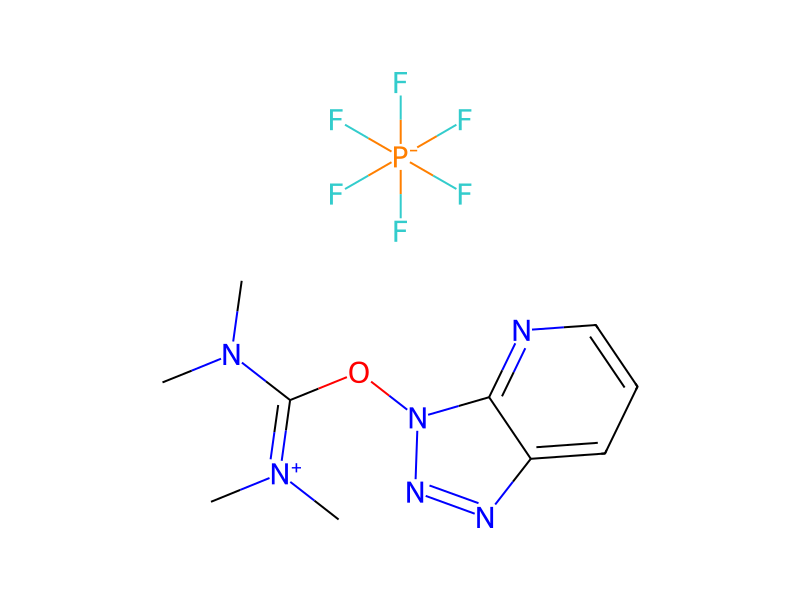
[Br:1][C:2]1[CH:10]=[CH:9][C:5]([C:6]([OH:8])=O)=[C:4]([F:11])[CH:3]=1.F[P-](F)(F)(F)(F)F.C[N+](C)=C(N(C)C)ON1[C:27]2N=CC=[CH:31][C:26]=2[N:25]=N1.C(N(CC)C(C)C)(C)C.CC(N)C>C(Cl)Cl>[Br:1][C:2]1[CH:10]=[CH:9][C:5]([C:6]([NH:25][CH:26]([CH3:31])[CH3:27])=[O:8])=[C:4]([F:11])[CH:3]=1Participants
Reactant 4



Product 1

Reagents, catalysts & solvents 1

Procedure
A solution of 4-bromo-2-fluorobenzoic acid (1.50 g, 6.85 mmol, Combi-Blocks: Cat. # CA-4096), N,N,N′,N′-tetramethyl-O-(7-azabenzotriazol-1-yl)uronium hexafluorophosphate (2.86 g, 7.53 mmol), and N,N-diisopropylethylamine (2.4 mL, 14 mmol) in methylene chloride (20. mL) was stirred for 10 minutes. 2-Propanamine (2.3 mL, 27 mmol) was then added and stirring was continued for 1.5 hours LC/MS data indicated that the major reaction component was the desired product. The reaction mixture was diluted with methylene chloride (40 mL) and H2O (3 mL). The layers were separated and the organic layer was washed with water (3×3 mL) and 1N HCl (3×3 mL). The combined aqueous phases were extracted with methylene chloride (5 mL). The combined organic layers were washed with brine (3 mL), dried over Na2SO4, filtered and concentrated in-vacuo. The crude product was purified by flash chromatography on a silica gel column eluting with ethyl acetate in hexanes (0-15%) to afford the desired product. LCMS (M+H)+: m/z=260.0/262.0.
Sources & evidence
- ORD record
- ord-da2c9ce113cf4782bd326af2678f84bf
- Source dataset
- uspto-grants-2014_04
- Patent number
- US08691807B2
Reaction notes
Loading…