p-Fluoronitrobenzene → ethyl 1-(4-nitrophenyl)-1H-imidazole-4-carboxylate
Reaction equation

[NH:1]1[CH:5]=[C:4]([C:6]([O:8][CH2:9][CH3:10])=[O:7])[N:3]=[CH:2]1.F[C:12]1[CH:17]=[CH:16][C:15]([N+:18]([O-:20])=[O:19])=[CH:14][CH:13]=1.C(=O)([O-])[O-].[K+].[K+]>C(#N)C>[N+:18]([C:15]1[CH:16]=[CH:17][C:12]([N:1]2[CH:5]=[C:4]([C:6]([O:8][CH2:9][CH3:10])=[O:7])[N:3]=[CH:2]2)=[CH:13][CH:14]=1)([O-:20])=[O:19]Participants
5
Reactant 3
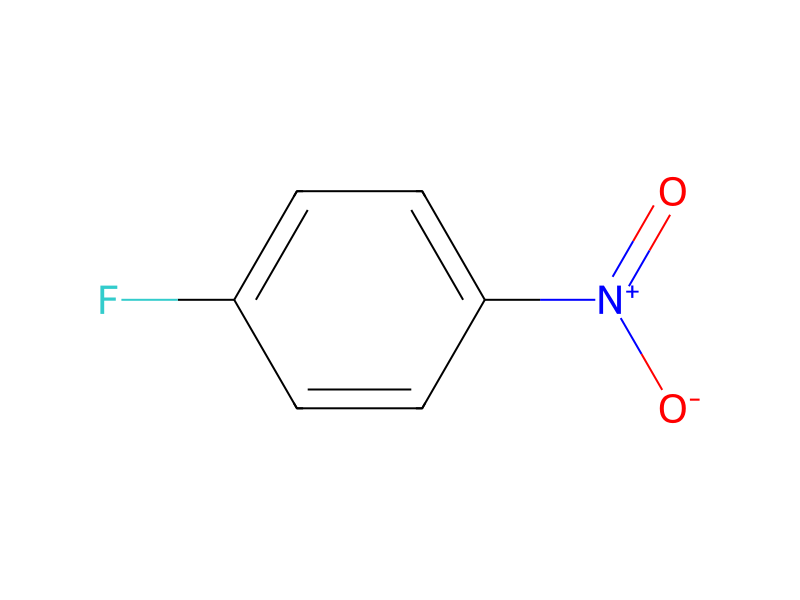


Product 1

Reagents, catalysts & solvents 1

Conditions
- Temperature
- 60 °C
Procedure
A mixture of ethyl 1H-imidazole-4-carboxylate (8 g, 57.1 mmol), 4-fluoro-1-nitrobenzene (8.05 g, 57.1 mmol) and potassium carbonate (8.68 g, 62.8 mmol) in acetonitrile (100 mL) was stirred at 60° C. for 16 h then cooled to room temperature and most the solvent was removed in vacuo. The residue was partitioned between AcOEt (200 mL) and water (150 mL) and the layers were separated. The organic phase was dried over MgSO4 and concentrated in vacuo. Purification of the residue by flash chromatography on silica gel (gradient: 0 to 5% MeOH in DCM) gave ethyl 1-(4-nitrophenyl)-1H-imidazole-4-carboxylate (12.53 g, 48.0 mmol, 84%) as a yellow oil.
Workup
- temperaturethen cooled to room temperature
- custommost the solvent was removed in vacuo
- customThe residue was partitioned between AcOEt (200 mL) and water (150 mL)
- customthe layers were separated
- dry with materialThe organic phase was dried over MgSO4
- concentrationconcentrated in vacuo
- customPurification of the residue by flash chromatography on silica gel (gradient: 0 to 5% MeOH in DCM)
Sources & evidence
- ORD record
- ord-8a8af0830f3d4e42be10cc3378a45794
- Source dataset
- uspto-grants-2014_04
- Patent number
- US08697725B2
Reaction notes
Loading…