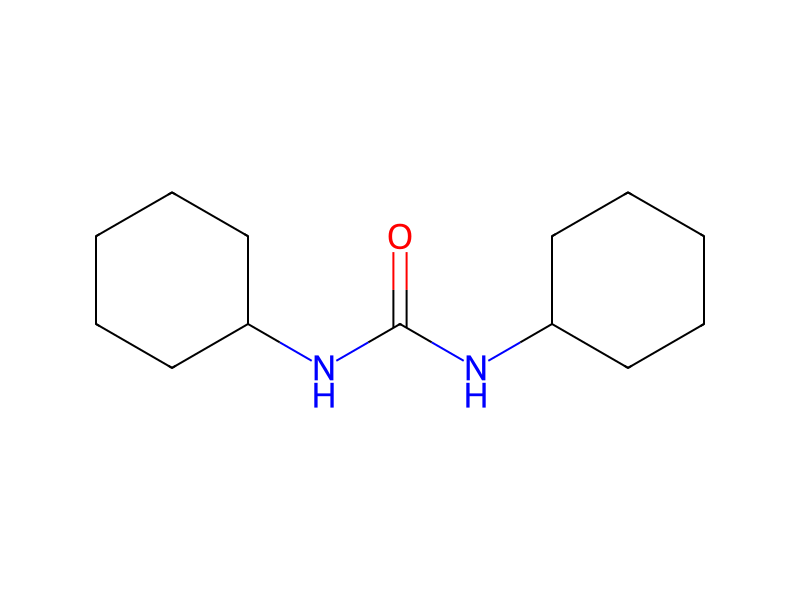
Dicyclohexylcarbodiimide → N,N'-Dicyclohexylurea
Reaction equation

C(N1C(C(O)=O)CSC1(C)C)(=[O:8])C1C=CC=CC=1.ON1C2C=CC=CC=2N=N1.[CH:29]1([N:35]=[C:36]=[N:37][CH:38]2[CH2:43][CH2:42][CH2:41][CH2:40][CH2:39]2)[CH2:34][CH2:33][CH2:32][CH2:31][CH2:30]1>O1CCCC1>[C:36]([NH:35][CH:29]1[CH2:30][CH2:31][CH2:32][CH2:33][CH2:34]1)([NH:37][CH:38]1[CH2:43][CH2:42][CH2:41][CH2:40][CH2:39]1)=[O:8]Participants




Procedure
To a solution of 48 g. (181 mmole) of 3-benzoyl-2,2-dimethyl-4-thiazolidinecarboxylic acid, prepared by the procedure described by Example 1, in 1.5 l. of tetrahydrofuran were added 27.8 g. (181 mmole) of 1-hydroxybenzotriazole followed by 37.4 g. (181 mmole) of dicyclohexylcarbodiimide. The mixture was stirred for 30 minutes at room temperature. The reaction mixture developed into a thick slurry resulting from the precipitation of dicyclohexylurea. To the heavy slurry was added 63 g. (181 mmole) of benzyl D-4-benzyloxyphenylglycinate and the reaction mixture was stirred at room temperature for about 2 hours. The reaction mixture was filtered to remove the dicyclohexylurea, the filtrate evaporated under reduced pressure, and the residue was dissolved in ethyl acetate. The solution was washed successively with 5% hydrochloric acid, water, aqueous sodium bicarbonate, and finally with water. The washed solution was dried, treated with carbon, and evaporated to dryness under reduced pressure to yield 107 g. (99% yield) of N-[α-(benzyl D-4-benzyloxyphenylacetate]- 3-benzoyl-2,2-dimethyl-4-thiazolidinecarboxamide.
Sources & evidence
- ORD record
- ord-a91da95eef7e4fb38e0a9f87b4138773
- Source dataset
- uspto-grants-1979_06
- Patent number
- US04158004
Reaction notes
Loading…