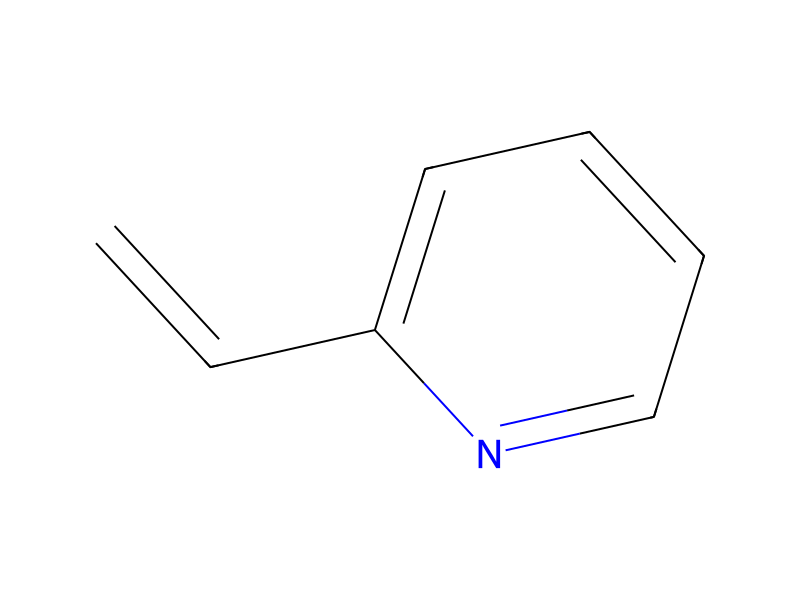
Piperidine → 2-Vinylpyridine
Reaction equation

Cl.[Cl-].[N:3]1[CH:8]=[CH:7][CH:6]=[CH:5][C:4]=1[CH2:9][CH2:10][N+:11]1[CH:16]=[CH:15][C:14](C#N)=[CH:13][CH:12]=1.N1CCCCC1.[OH-].[Na+]>O>[N:10]1([C:11]2[CH:12]=[CH:13][N:14]=[CH:15][CH:16]=2)[CH2:9][CH2:4][CH2:3][CH2:8][CH2:7]1.[CH:9]([C:4]1[CH:5]=[CH:6][CH:7]=[CH:8][N:3]=1)=[CH2:10]Participants
6
Reactant 3



Product 2

Reagents, catalysts & solvents 1

Procedure
To 28.1 parts of this 1-[2-(2-pyridyl)ethyl]-4-cyanopyridinium chloride hydrochloride in 150 parts water was added 24 parts of piperidine, and the resulting mixture stirred for 2.5 hours at ambient temperature. 300 parts of 40% sodium hydroxide was added, and the reaction heated to 100° C. for two hours, cooled, and the organic layer separated. Distillation of the organic layer gave 15 parts 4-piperidinopyridine and 10 parts 2-vinylpyridine which was subsequently recycled for use in preparing more pyridylethyl salts.
Workup
- temperaturethe reaction heated to 100° C. for two hours
- temperaturecooled
- customthe organic layer separated
- distillationDistillation of the organic layer
Sources & evidence
- ORD record
- ord-7fc8db00f2d342e880e026bf796c2cbf
- Source dataset
- uspto-grants-1979_06
- Patent number
- US04158093
Reaction notes
Loading…