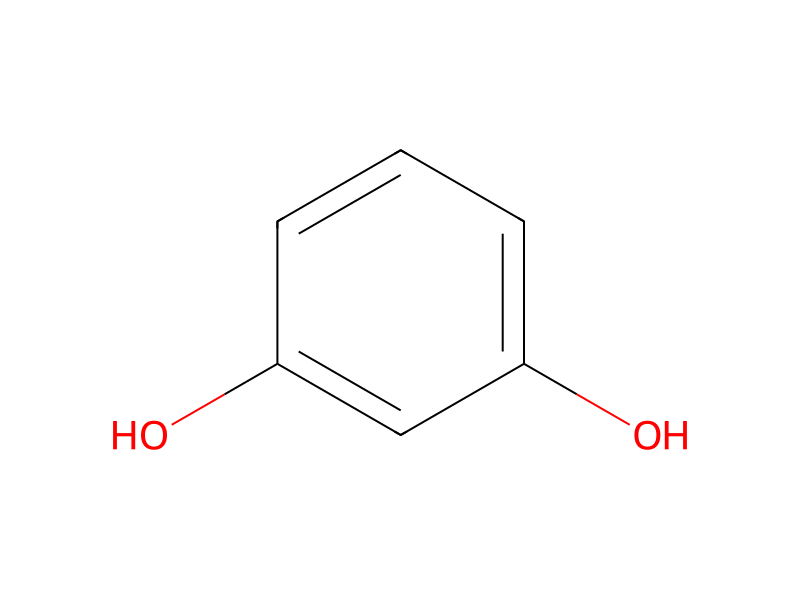
Resorcinol → 1-(2,4-Dihydroxyphenyl)-2-(3-hydroxyphenyl)ethan-1-one
Reaction equation

[C:1]1([CH:8]=[CH:7][CH:6]=[C:4]([OH:5])[CH:3]=1)[OH:2].[OH:9][C:10]1[CH:11]=[C:12]([CH2:16][C:17](O)=[O:18])[CH:13]=[CH:14][CH:15]=1.B(F)(F)F.CCOCC.C([O-])(=O)C.[Na+]>C1(C)C=CC=CC=1.O>[OH:2][C:1]1[CH:3]=[C:4]([OH:5])[CH:6]=[CH:7][C:8]=1[C:17](=[O:18])[CH2:16][C:12]1[CH:13]=[CH:14][CH:15]=[C:10]([OH:9])[CH:11]=1Participants
7





Procedure
A solution of resorcinol (3.56 g, 32.3 mmol), 2-(3-hydroxyphenyl)acetic acid (5.39 g, 35.4 mmol), and boron trifluoride etherate (12 mL) in toluene (10 mL) was heated at 90° C. for 2 h. The reaction mixture was allowed to cool to room temperature, and a solution of 12% sodium acetate in H2O (17 mL) was added. After stirring for 3 h, the resulting precipitate was collected by filtration to give 1-(2,4-dihydroxyphenyl)-2-(3-hydroxyphenyl)ethanone (4.47 g, 57%) as a yellow solid. 1H NMR (DMSO-d6): δ 12.57 (s, 1H), 10.67 (s, 1H), 9.34 (s, 1H), 7.92 (d, 1H), 7.09 (m, 2H), 6.65 (m, 2H), 6.40 (m, 1H), 6.25 (s, 1H), 4.14 (s, 2H).
Workup
- filtrationthe resulting precipitate was collected by filtration
Sources & evidence
- ORD record
- ord-48e638b0903243c3adbd89fbdcbda95e
- Source dataset
- uspto-grants-2014_04
- Patent number
- US08703810B2
Reaction notes
Loading…