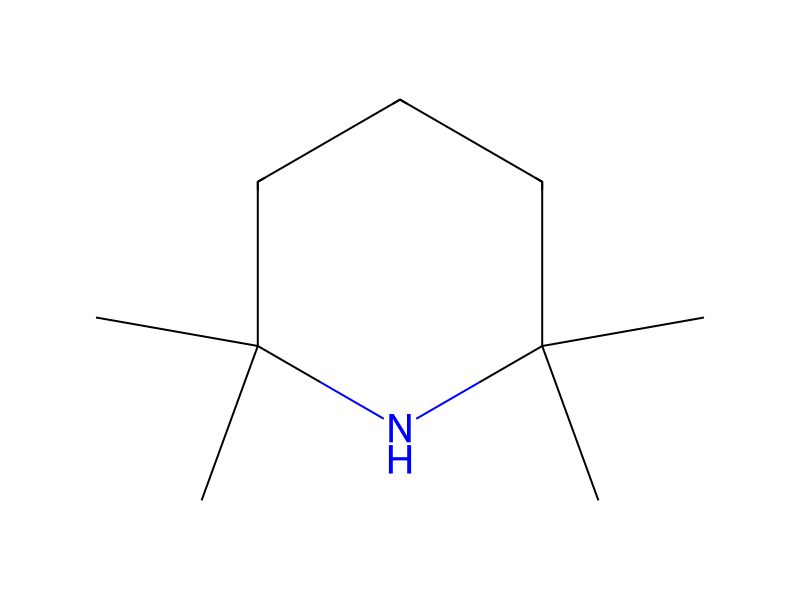
2,2,6,6-Tetramethylpiperidine → HCID 58075622, compound
Reaction equation

[Cl:1][C:2]1[CH:7]=[C:6]([O:8][CH3:9])[N:5]=[C:4]([O:10][CH3:11])[N:3]=1.[CH2:12]([Li])[CH2:13][CH2:14]C.CC1(C)CCCC(C)(C)N1>>[CH2:14]([C:7]1[C:2]([Cl:1])=[N:3][C:4]([O:10][CH3:11])=[N:5][C:6]=1[O:8][CH3:9])[CH:13]=[CH2:12]Participants



Procedure
Synthesis of 2,4-dichloro-7-aryl-6,7-dihydro-5H-cyclopenta[d]pyrimidines 33 could also be performed according to the pathway described on Scheme 9. 4-Chloro-2,6-dimethoxypyrimidine 40 could be deprotonated with a strong base, such as n-butyllithium or 2,2,6,6-tetramethylpiperidine, and quenched with allyl bromide to give 5-allyl-4-chloro-2,6-dimethoxypyrimidine 41. Nencka, R.; Votruba, I.; H{hacek over (r)}ebabecký, H.; Jansa, P.; Tlou{hacek over (s)}t'ová, E.; Horská, K.; Masojídková, M.; Holý, A. J. Med. Chem. 2007, 50, 6016-6023. The latter compound can react with α-styrylborinic acids in the presence of a palladium catalyst, such as tetrakis(triphenylphosphine)palladium, to provide compounds of formula 42 which can undergo ring closure olefin metathesis under Grubbs conditions to form 2,4-dimethoxy-7-aryl-5H-cyclopenta[d]pyrimidines 43. Grubbs, R. H. Handbook of Metathesis, 2003, First Edition, Wiley-VCH. The double bond in compounds 43 can be reduced to give 2,4-dimethoxy-7-aryl-6,7-dihydro-5H-cyclopenta[d]pyrimidines 44, which upon acid-catalyzed hydrolysis, followed by chlorination with phosphorus oxychloride afford intermediates 33.
Workup
- customquenched with allyl bromide
Sources & evidence
- ORD record
- ord-adb59f0c19ef44e8817f520a6f264cab
- Source dataset
- uspto-grants-2014_04
- Patent number
- US08710061B2
Reaction notes
Loading…