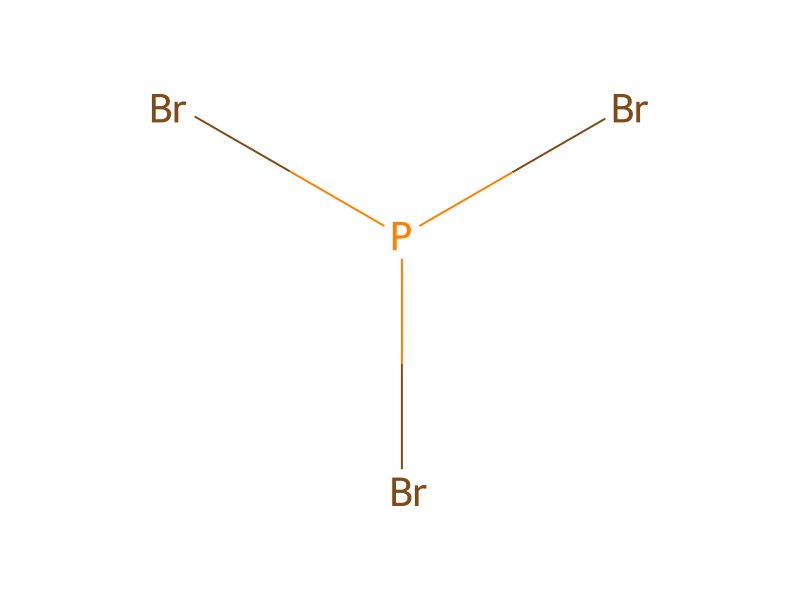
Phosphorus tribromide → 2-Bromo-1-fluoro-3,5-dinitrobenzene
Reaction equation

[N+:1]([C:4]1[CH:9]=[C:8]([N+:10]([O-:12])=[O:11])[C:7](O)=[C:6]([F:14])[CH:5]=1)([O-:3])=[O:2].P(Br)(Br)[Br:16]>CN(C=O)C.C1(C)C=CC=CC=1>[Br:16][C:7]1[C:6]([F:14])=[CH:5][C:4]([N+:1]([O-:3])=[O:2])=[CH:9][C:8]=1[N+:10]([O-:12])=[O:11]Participants
5
Reactant 2

Product 1

Reagents, catalysts & solvents 2


Conditions
- Temperature
- 110 °C
Procedure
To a solution of 4,6-dinitro-2-fluorophenol (8 g, 39.60 mmol, 1 equiv) in DMF (24 mL) and toluene (160 mL), PBr3 (5.6 mL, 59.40 mmol, 1.5 equiv) was added at room temperature. Then the reaction mixture was heated at 110° C. for 1 hour. After allowing to cool to room temperature, the upper colorless layer was poured into a separate funnel and diluted with hexanes. The organic layer was washed with water, dried over MgSO4 and evaporated to dryness to give the product (10.3 g, 98%) as a yellow solid.
Workup
- temperatureto cool to room temperature
- additionthe upper colorless layer was poured into a separate funnel
- washThe organic layer was washed with water
- dry with materialdried over MgSO4
- customevaporated to dryness
Sources & evidence
- ORD record
- ord-b34d1238164a4a7c895a5e464c745162
- Source dataset
- uspto-grants-2014_04
- Patent number
- US08710223B2
Reaction notes
Loading…