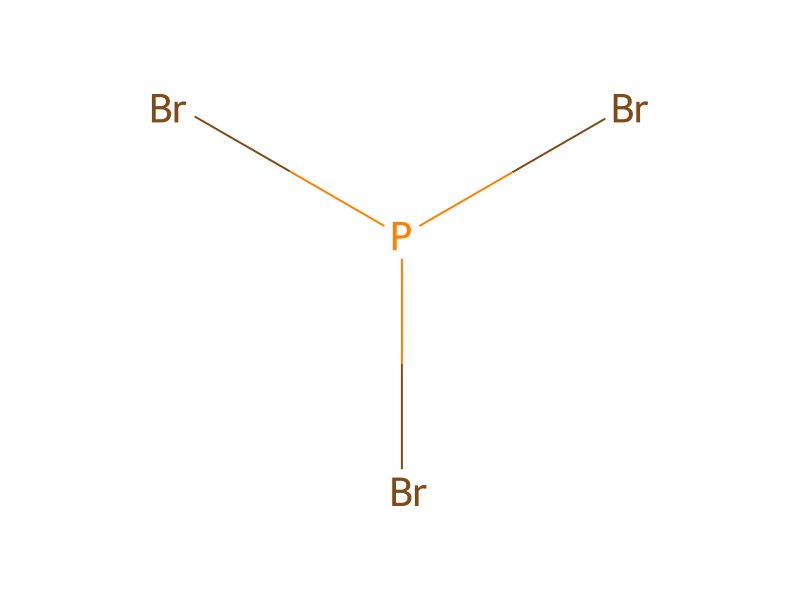
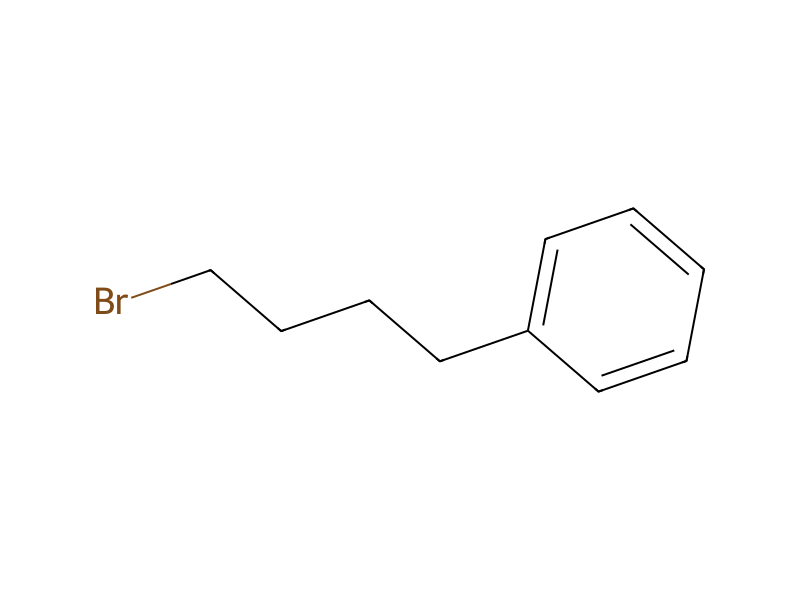
Phosphorus tribromide → 1-Bromo-4-phenylbutane
Reaction equation

[C:1]1([CH2:7][CH2:8][CH2:9][CH2:10]O)[CH:6]=[CH:5][CH:4]=[CH:3][CH:2]=1.P(Br)(Br)[Br:13]>C(OCC)(=O)C>[Br:13][CH2:10][CH2:9][CH2:8][CH2:7][C:1]1[CH:6]=[CH:5][CH:4]=[CH:3][CH:2]=1Participants
4
Reactant 2

Product 1
Reagents, catalysts & solvents 1

Procedure
To 1.50 g of 4-phenylbutanol was added 385 μl of phosphorus tribromide with ice cooling, and the mixture was stirred at a room temperature for 5 minutes and then at 80° C. for one hour. To the reaction mixture were added 20 ml of ice water and 30 ml of ethyl acetate. The separated organic layer was, successively washed with water, 5% sodium bicarbonate aqueous solution and a saturated sodium chloride aqueous solution, dried over magnesium sulfate, and evaporated under a reduced pressure to obtain an oily residue. The residue was applied to a silica gel column and eluted with hexane/benzene (6:1) to obtain 1.94 g of (4-bromobutyl)benzene as a colorless liquid.
Workup
- waitat 80° C. for one hour
- washsuccessively washed with water, 5% sodium bicarbonate aqueous solution
- dry with materiala saturated sodium chloride aqueous solution, dried over magnesium sulfate
- customevaporated under a reduced pressure
- customto obtain an oily residue
- washeluted with hexane/benzene (6:1)
Sources & evidence
- ORD record
- ord-b0cd04f726ac4771b32e0d6433a3d52d
- Source dataset
- uspto-grants-1992_03
- Patent number
- US05093370
Reaction notes
Loading…