Triethylene Glycol → Benzil
Reaction equation

C[O:2][C:3](OC)([C:10]([C:12]1[CH:17]=[CH:16][CH:15]=[CH:14][CH:13]=1)=[O:11])[C:4]1[CH:9]=[CH:8][CH:7]=[CH:6][CH:5]=1.C(O)COCCOCCO.O.C1(C)C=CC(S(O)(=O)=O)=CC=1>>[C:12]1([C:10]([C:3]([C:4]2[CH:9]=[CH:8][CH:7]=[CH:6][CH:5]=2)=[O:2])=[O:11])[CH:13]=[CH:14][CH:15]=[CH:16][CH:17]=1Participants
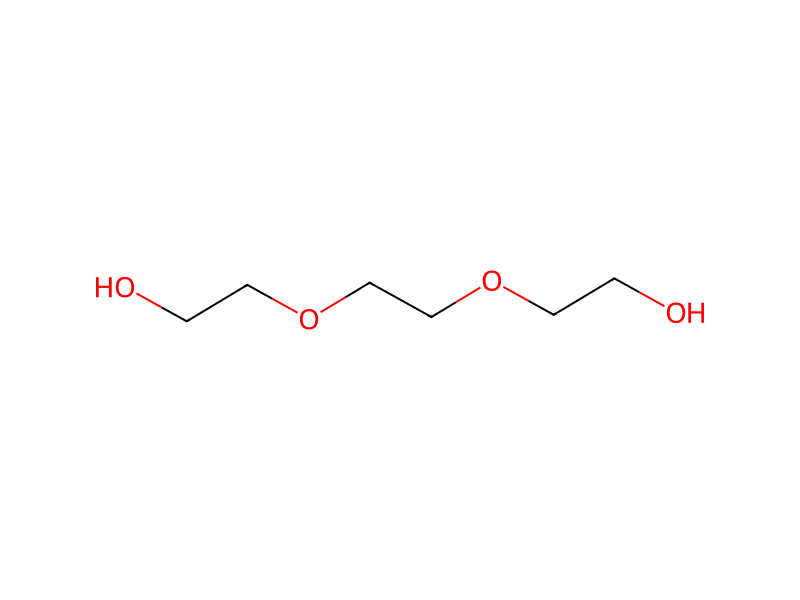


Procedure
A mixture of 153.8 g (0.6 mole) of benzil dimethyl ketal, 90.1 g (0.6 mole) of triethylene glycol and 3.9 g of toluene-4-sulfonic acid monohydrate are heated to 75°-85° C. under an aspirator vacuum (20-30 mbar). At about 63° C., everything is dissolved. The course of the reaction is monitored by thin-layer chromatography. The reaction is stopped as soon as less than 1% of benzil dimethyl ketal is present in the mixture or the amount of benzil formed is larger than the amount of benzil dimethyl ketal still present. This is the case after 2-3 hours. The yellow solution is then cooled and neutralized with 3.8 g of a 30% solution of sodium methylate in methanol. The mixture is then heated to 60° C. under an aspirator vacuum and the methanol is distilled off. The liquid residue is diluted with 500 ml of toluene, stirred with 10 g of activated carbon and filtered through a Hyflo bed. The filtrate is evaporated in vacuo. This gives 208.8 g of a yellow, viscous oil (photoinitiator no. 1).
Workup
- temperatureare heated to 75°-85° C. under an aspirator vacuum (20-30 mbar)
- dissolutionAt about 63° C., everything is dissolved
Sources & evidence
- ORD record
- ord-e7b8118eeeac4a8f8073252d36e6a13f
- Source dataset
- uspto-grants-1992_03
- Patent number
- US05095044
Reaction notes
Loading…