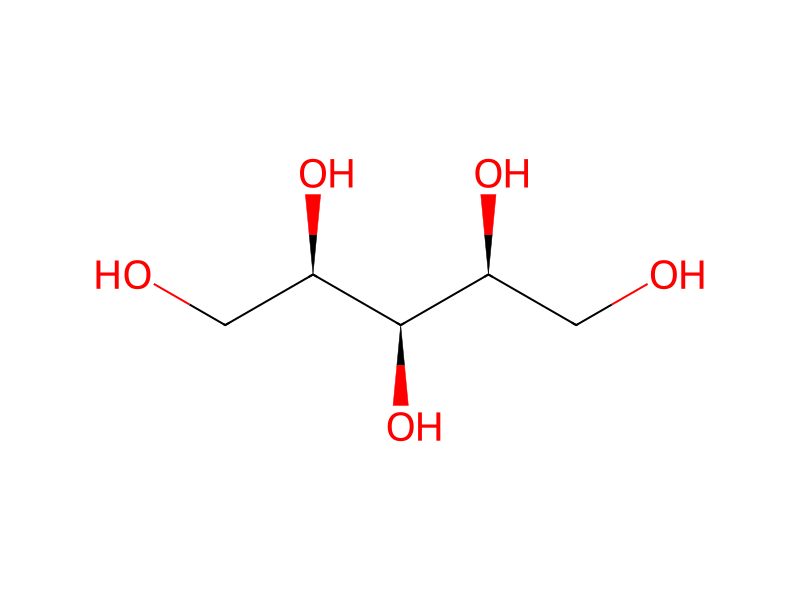
D-Arabitol → D-Arabitol
Reaction equation

[CH2:1]([OH:10])[C@@H:2]([OH:9])[CH:3]([OH:8])[C@H:4]([OH:7])[CH2:5][OH:6].[CH2:11]([OH:20])[C@@H:12]([C@H:14]([C@@H:16]([CH2:18][OH:19])[OH:17])[OH:15])[OH:13]>>[CH2:1]([OH:10])[C@@H:2]([OH:9])[CH:3]([OH:8])[C@H:4]([OH:7])[CH2:5][OH:6].[O:20]=[CH:11][C@@H:12]([C@H:14]([C@@H:16]([C@@H:18]([CH2:5][OH:6])[OH:19])[OH:17])[OH:15])[OH:13]Participants
4


Procedure
The fermentation is continued at a temperature close to 30° C. for 80 to 100 hours under aeration corresponding to 1 to 1.5 volume of air/volume of culture/minute, and at a pH comprised between 4 and 6, preferably close to 4.5, advantageously maintained by ammonia, due to which there is generally obtained a content of D-arabitol of 65 to 90 g/l, this arabitol representing from 70 to 85% of the matter present in the culture medium at the end of this fermentation, the sugar impurities being particularly constituted by xylitol formed similarly with the arabitol and through non-fermented glucose.
Sources & evidence
- ORD record
- ord-4c3bc77fba9b47f3b0fbaf60cfd56a79
- Source dataset
- uspto-grants-1992_03
- Patent number
- US05096820
Reaction notes
Loading…