Monobenzone → HCID 19902898, compound
Reaction equation

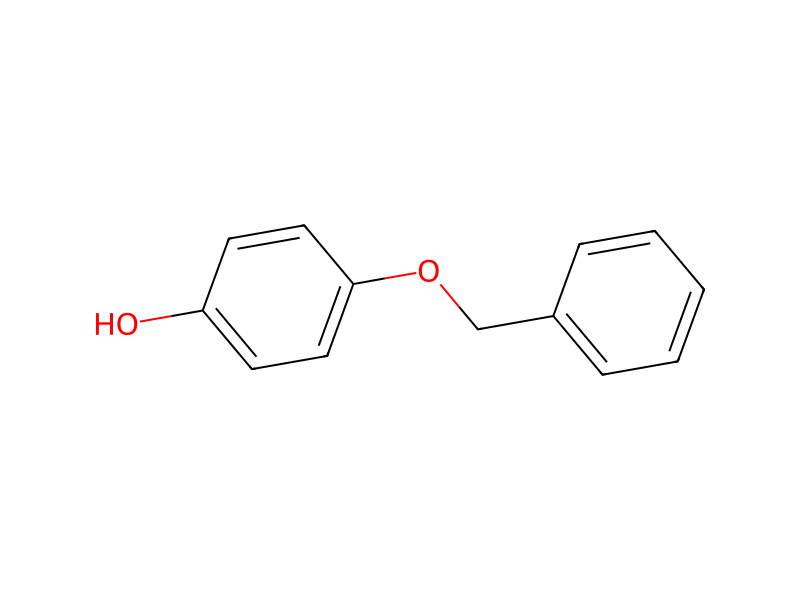
[C:1]([O:4][C:5]1[CH:13]=[CH:12][C:8]([C:9](Cl)=[O:10])=[CH:7][CH:6]=1)(=[O:3])[CH3:2].[CH2:14]([O:21][C:22]1[CH:27]=[CH:26][C:25]([OH:28])=[CH:24][CH:23]=1)[C:15]1[CH:20]=[CH:19][CH:18]=[CH:17][CH:16]=1.C(N(CC)CC)C.C1C=CC=CC=1.CCCCCC>C(OCC)C>[C:1]([O:4][C:5]1[CH:13]=[CH:12][C:8]([C:9]([O:28][C:25]2[CH:24]=[CH:23][C:22]([O:21][CH2:14][C:15]3[CH:16]=[CH:17][CH:18]=[CH:19][CH:20]=3)=[CH:27][CH:26]=2)=[O:10])=[CH:7][CH:6]=1)(=[O:3])[CH3:2]Participants
Reactant 4



Product 1

Reagents, catalysts & solvents 1

Procedure
In diethyl ether were dissolved 1.99 g of 4-acetoxybenzoic acid chloride and 2.00 g of 4-benzyloxyphenol, 2.00 g of triethylamine was added to the solution, and a reaction was carried out at room temperature with stirring overnight. The reacted mixture was washed three times with 1N hydrochloric acid, a 1N aqueous solution of sodium hydrogencarbonate and water, in this order, and the ether solution was dried with anhydrous magnesium sulfate. Diethyl ether was evaporated and the product was isolated from the residue by silica gel column chromatography using benzene/n-hexane mixed solvent as eluant and 2.81 g of 4-benzyloxyphenyl 4-acetoxybenzoate was obtained. Then ethyl acetate was added to the reaction product to dissolve the reaction product, 6 g of 5%Pd/C was added to the solution, and a reaction was carried out at room temperature in a hydrogen atmosphere overnight. The Pd/C was removed by filtration, the solvent was removed from the reacted solution, and the residue was recrystallized from an n-hexane/ethanol mixed solvent to obtain 2.24 g of 4-acetoxybenzoyloxy-4-phenol. The product was dissolved in 100 ml of diethyl ether, 2.08 g of 4-n-decyloxybenzoic acid chloride and 1.40 g of triethylamine were added to the solution successively, and a reaction was carried out with stirring at room temperature overnight. The product was extracted from the reacted solution with 200 ml of benzene, and the extract was washed three times with 1N hydrochloric acid, a 1N aqueous solution of sodium hydrogencarbonate and water, in this order. The organic phase was recovered and dried with anhydrous magnesium sulfate, the organic solvent was evaporated, and the residue was dissolved in 100 ml of a THF-methanol (9/1) mixed solvent. Then 1 ml of a 1N aqueous solution of lithium hydroxide was added to the solution cooled with ice-cold water and a reaction was carried out with stirring for 30 minutes. The reacted mixture was made weakly acidic by an addition of 1N hydrochloric acid, extracted with a diethyl ether/benzene (1/1) mixed solvent, and the extract was washed three times with 1N hydrochloric acid, a 1N aqueous solution of sodium hydrogencarbonate and water, in this order. The organic phase was recovered and dried with anhydrous magnesium sulfate, the organic solvent was evaporated, and the product was isolated from the residue by silica gel column chromatography using benzene/n-hexane as eluant and 4-hydroxybenzoyloxyphenyl 4-decyloxybenzoate was obtained. The product was recrystallized from an n-hexane/ethanol mixed solvent to obtain 2.19 g of a purified product.
Workup
- additionwas added to the solution
- customwas carried out at room temperature
- washThe reacted mixture was washed three times with 1N hydrochloric acid
- dry with materiala 1N aqueous solution of sodium hydrogencarbonate and water, in this order, and the ether solution was dried with anhydrous magnesium sulfate
- customDiethyl ether was evaporated
- customthe product was isolated from the residue by silica gel column chromatography
Sources & evidence
- ORD record
- ord-58ff61aac41149cfb6e9bf6f88829114
- Source dataset
- uspto-grants-1992_03
- Patent number
- US05098599
Reaction notes
Loading…