Hydrochloric Acid → 2-(4-(Methoxycarbonyl)phenyl)acetic acid
Reaction equation

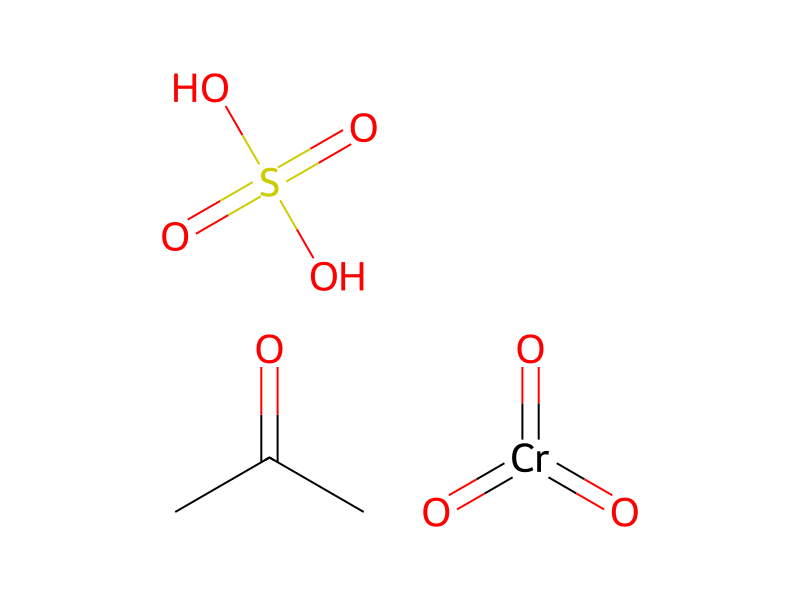
C[O:2][CH:3]=[CH:4][C:5]1[CH:14]=[CH:13][C:8]([C:9]([O:11][CH3:12])=[O:10])=[CH:7][CH:6]=1.Cl.CC(C)=[O:18].OS(O)(=O)=O.O=[Cr](=O)=O.C(O)(C)C>O1CCOCC1.O>[CH3:12][O:11][C:9]([C:8]1[CH:13]=[CH:14][C:5]([CH2:4][C:3]([OH:18])=[O:2])=[CH:6][CH:7]=1)=[O:10]Participants






Conditions
- Temperature
- -50 °C
Procedure
To a solution of methyl 4-(2-methoxyethenyl)benzoate (E9) (2.41 g, 12.5 mmol) in dioxane (50 ml) 1N water solution of HCl (40 ml) was added and the resultant mixture was stirred at room temperature for 12 hours. The reaction mixture was extracted with ethyl acetate (3×50 ml), the organic extracts were combined, washed with brine (2×30 ml), and dried (Na2SO4). The solvents were evaporated, the residue was dissolved in acetone (70 ml) and cooled to −50° C. To the cold solution at this temperature slowly (ca. for 5 minutes) 2.67 M Jones reagent (CrO3/H2SO4; 7.5 ml, 20.0 mmol) was added and the obtained mixture was stirred at −40 to −50° C. for 1 hour and at −30° C. for 20 minutes. Isopropyl alcohol (2 ml) was added to the reaction mixture and the cooling bath was removed allowing the reaction to warm up for 10 minutes. The mixture was poured into water (150) and extracted with ethyl acetate (3×100 ml). The organic layers were combined, washed with brine (2×50), and dried (Na2SO4). The solvent was evaporated and the residue was dissolved in a small amount of hot dioxane (1-2 ml). Addition of petroleum ether (4-6 ml) caused the formation of a precipitate. The mixture was filtered and the precipitate was washed with dioxane-petroleum ether (1:4). The filtrate was evaporated and the precipitate formation procedure was repeated as described above. Then the filtrate was evaporated and the residue was chromatographed on silicagel (100 g) with petroleum ether-dioxane-acetic acid (2.5:7.5:0.1) to give the title compound (0.681 g, 28%) as a white solid. 1H NMR (CDCl3, HMDSO) δ: 3.68 (2H, s); 3.89 (3H, s); 7.33 (2H, d, J=8.2 Hz); 7.97 (2H, d, J=8.2 Hz); 10.82 (1H, br s).
Workup
- extractionThe reaction mixture was extracted with ethyl acetate (3×50 ml)
- washwashed with brine (2×30 ml)
- dry with materialdried (Na2SO4)
- customThe solvents were evaporated
- dissolutionthe residue was dissolved in acetone (70 ml)
- customthe cooling bath was removed
- customthe reaction
- temperatureto warm up for 10 minutes
- extractionextracted with ethyl acetate (3×100 ml)
- washwashed with brine (2×50)
- dry with materialdried (Na2SO4)
- customThe solvent was evaporated
- dissolutionthe residue was dissolved in a small amount of hot dioxane (1-2 ml)
- additionAddition of petroleum ether (4-6 ml)
- filtrationThe mixture was filtered
- washthe precipitate was washed with dioxane-petroleum ether (1:4)
- customThe filtrate was evaporated
- customThen the filtrate was evaporated
- customthe residue was chromatographed on silicagel (100 g) with petroleum ether-dioxane-acetic acid (2.5:7.5:0.1)
Sources & evidence
- ORD record
- ord-39098bdc3eb8488f8ca734b2f6d702dd
- Source dataset
- uspto-grants-2008_12
- Patent number
- US07465719B2
Reaction notes
Loading…