Dichloromethane → HCID 40989960, compound
Reaction equation

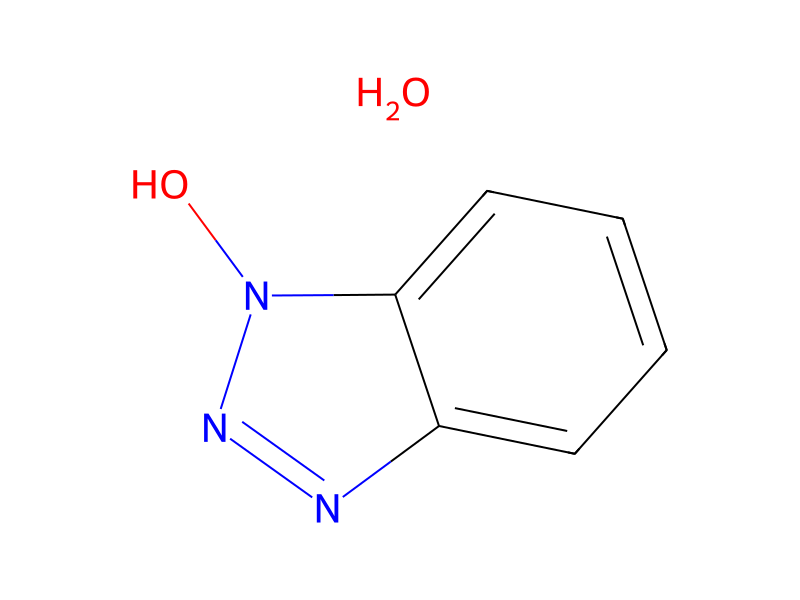
[Br:1][C@@H:2]([CH3:6])[C:3](O)=[O:4].[NH2:7][C:8]1[CH:13]=[CH:12][CH:11]=[C:10]([CH3:14])[CH:9]=1.O.ON1C2C=CC=CC=2N=N1.C1(N=C=NC2CCCCC2)CCCCC1.ClCCl>O1CCCC1>[Br:1][C@@H:2]([CH3:6])[C:3]([NH:7][C:8]1[CH:13]=[CH:12][CH:11]=[C:10]([CH3:14])[CH:9]=1)=[O:4]Participants
7






Conditions
- Temperature
- 0 °C
Procedure
To a solution of (S)-(−)-2-bromopropionic acid (0.25 mL, 2.77 mmol), m-toluidine (0.30 mL, 2.77 mmol) and 1-hydroxybenzotriazole hydrate (560 mg, 4.16 mmol) in tetrahydrofuran (25 mL) was added a 1M solution of 1,3-dicyclohexylcarbodiimide in dichloromethane (5.54 mL, 5.54 mmol). The mixture was stirred at about 0° C. for about 2 hours, then it was warmed to room temperature and filtered. The filtrate was concentrated and the residue was purified by flash chromatography on silica gel using hexane/ethyl acetate (2:1) as eluent to provide the desired product. MS (DCI-NH3): m/z 259, 261 (M+NH4)+.
Workup
- temperatureit was warmed to room temperature
- filtrationfiltered
- concentrationThe filtrate was concentrated
- customthe residue was purified by flash chromatography on silica gel
Sources & evidence
- ORD record
- ord-b95a9e7c145546fe83ca3d53c0aae671
- Source dataset
- uspto-grants-2008_12
- Patent number
- US07468371B2
Reaction notes
Loading…