Terazosin Hydrochloride → Terazosin
Reaction equation

[CH3:1][O:2][C:3]1[CH:8]=[C:7]2[C:9]([NH2:26])=[N:10][C:11]([N:13]3[CH2:18][CH2:17][N:16]([C:19]([CH:21]4[O:25][CH2:24][CH2:23][CH2:22]4)=[O:20])[CH2:15][CH2:14]3)=[N:12][C:6]2=[CH:5][C:4]=1[O:27][CH3:28].O.O.Cl>C(O)C>[CH3:1][O:2][C:3]1[CH:8]=[C:7]2[C:9]([NH2:26])=[N:10][C:11]([N:13]3[CH2:18][CH2:17][N:16]([C:19]([CH:21]4[O:25][CH2:24][CH2:23][CH2:22]4)=[O:20])[CH2:15][CH2:14]3)=[N:12][C:6]2=[CH:5][C:4]=1[O:27][CH3:28]Participants
3
Reactant 1

Product 1
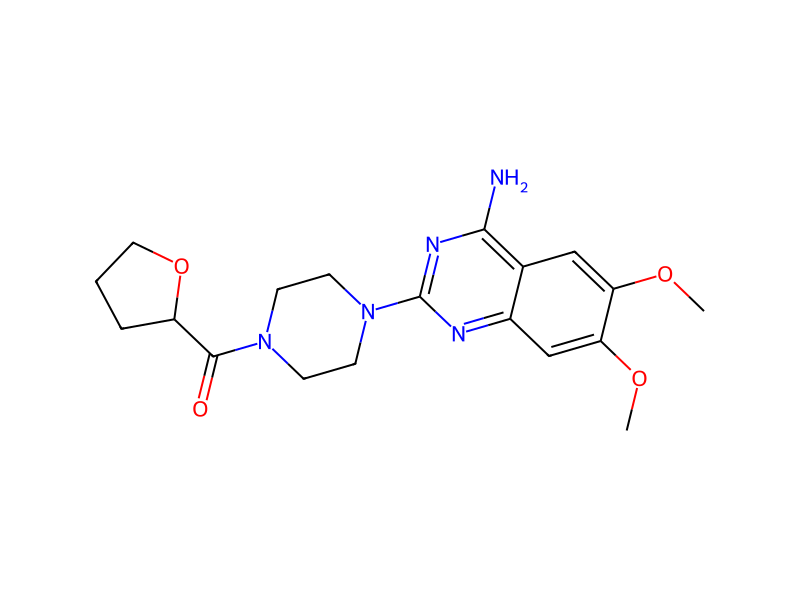
Reagents, catalysts & solvents 1

Procedure
To a 2-liter round-bottom flask containing 71.0 g (0.15 mol) of terazosin monohydrochloride dihydrate was added 1300 mL of absolute ethanol, a stirring bar and several glass boiling beads. The flask was fitted with a Dean-Stark trap and reflux condensor. The heterogenous mixture was heated under reflux for two days. After cooling, the undissolved white solid remaining in the flask was collected by vacuum filtration and washed with dry acetone to yield 60.9 g (0.143 mol, 93.5%) of the anhydrous crystalline polymorph of terazosin of this invention. The material was found by its powder x-ray diffraction pattern to be free of both the prior art anhydrous crystalline modification and the dihydrate form.
Workup
- customThe flask was fitted with a Dean-Stark trap
- temperaturereflux condensor
- temperatureThe heterogenous mixture was heated
- temperatureunder reflux for two days
- temperatureAfter cooling
- filtrationwas collected by vacuum filtration
- washwashed with dry acetone
Sources & evidence
- ORD record
- ord-c6467a64a2334146a6dbff801f20d4a7
- Source dataset
- uspto-grants-1994_11
- Patent number
- US05362730
Reaction notes
Loading…