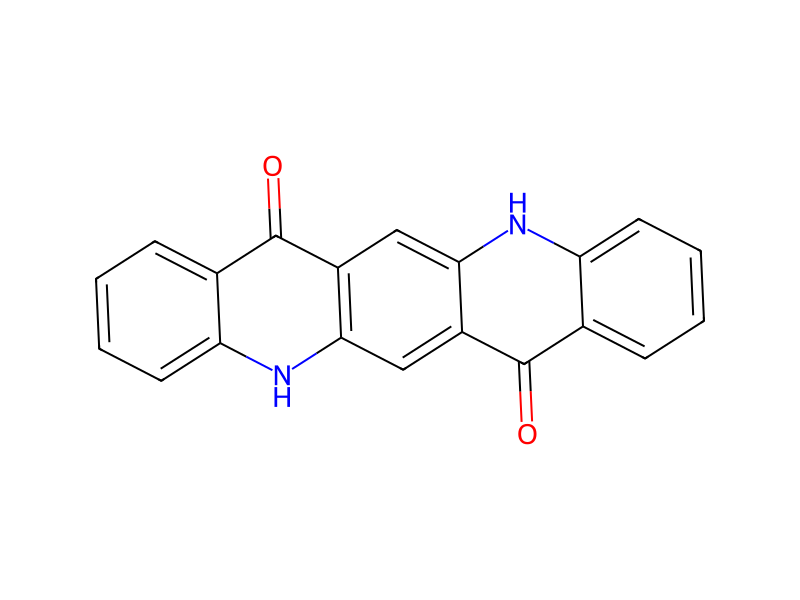
2,5-Dianilinoterephthalic acid → Quinacridone
Reaction equation

CC1C=CC(NC2C=C(C(O)=O)C(NC3C=CC(C)=CC=3)=CC=2C(O)=O)=CC=1.[C:29]1([NH:35][C:36]2[CH:44]=[C:43]([C:45](O)=[O:46])[C:42]([NH:48][C:49]3[CH:54]=[CH:53][CH:52]=[CH:51][CH:50]=3)=[CH:41][C:37]=2[C:38](O)=[O:39])[CH:34]=[CH:33][CH:32]=[CH:31][CH:30]=1>O>[CH:52]1[CH:53]=[C:54]2[C:45]([C:43]3[C:42]([NH:48][C:49]2=[CH:50][CH:51]=1)=[CH:41][C:37]1[C:38]([C:34]2[C:29]([NH:35][C:36]=1[CH:44]=3)=[CH:30][CH:31]=[CH:32][CH:33]=2)=[O:39])=[O:46]Participants
4
Reactant 2


Product 1
Reagents, catalysts & solvents 1

Procedure
A mixture of 85 parts of 2,5-di(4'-methylphenylamino)terephthalic acid and 15 parts of 2,5-diphenylaminoterephthalic acid is cyclized at 125° C. in 300 parts of monomethyl polyphosphate (P2O5 concentration: 81%). After hydrolysis of the ring closure melt in 1,200 parts of water at 20° C. in which 5 parts of (3'-dimethylaminopropyl) quinacridonebissulfonamide had been suspended, the crude quinacridone isolated was subjected to a solvent finish at 125° C.
Workup
- customAfter hydrolysis of the ring closure
Sources & evidence
- ORD record
- ord-25223f7985554992822a7d33d7f573d4
- Source dataset
- uspto-grants-1994_11
- Patent number
- US05368641
Reaction notes
Loading…