Triphenylphosphine → (5-Carboxypentyl)triphenylphosphanium bromide
Reaction equation

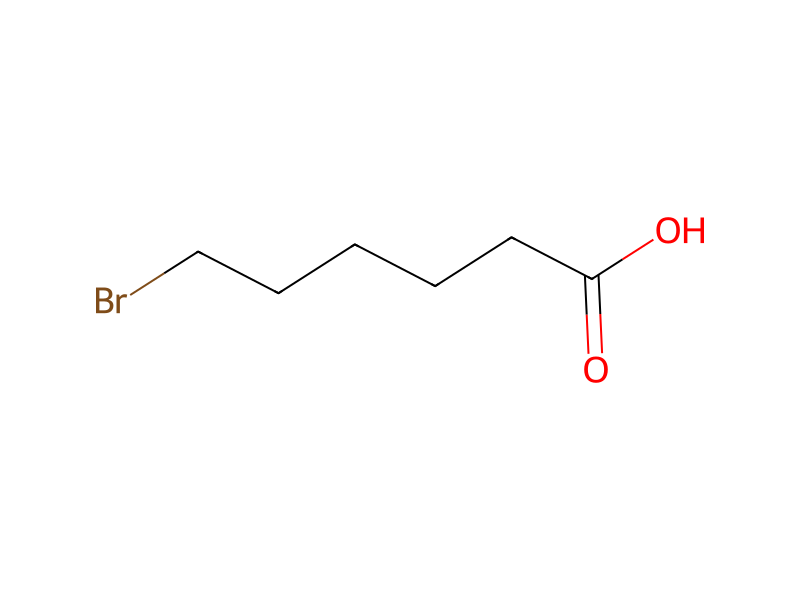
[Br:1][CH2:2][CH2:3][CH2:4][CH2:5][CH2:6][C:7]([OH:9])=[O:8].[C:10]1([P:16]([C:23]2[CH:28]=[CH:27][CH:26]=[CH:25][CH:24]=2)[C:17]2[CH:22]=[CH:21][CH:20]=[CH:19][CH:18]=2)[CH:15]=[CH:14][CH:13]=[CH:12][CH:11]=1>C(#N)C>[Br-:1].[C:7]([CH2:6][CH2:5][CH2:4][CH2:3][CH2:2][P+:16]([C:17]1[CH:18]=[CH:19][CH:20]=[CH:21][CH:22]=1)([C:23]1[CH:28]=[CH:27][CH:26]=[CH:25][CH:24]=1)[C:10]1[CH:11]=[CH:12][CH:13]=[CH:14][CH:15]=1)([OH:9])=[O:8]Participants
4
Reactant 2

Product 1

Reagents, catalysts & solvents 1

Procedure
A solution of 6-bromohexanoic acid (10.00 g, 51.27 mmol) and triphenyl phosphine (14.12 g, 53.83 mmol) in freshly distilled acetonitrile (50 mL) was vigorously stirred and refluxed for 48 hours. The solution was allowed to come to ambient temperature and the Wittig salt was precipitated upon scratching the inside wall of the glass reaction vessel with a spatula. The white solid product was collected, washed with ether and filtered to provide the title compound in 98% yield (22.87 g): 1H NMR (400 MHz, CD3OD) δ 1.62-1.72 (m, 6H), 2.29 (t, 2H), 3.40-3.47 (m, 2H), 7.76-7.91 (m, 15H).
Workup
- temperaturerefluxed for 48 hours
- customto come to ambient temperature
- customthe Wittig salt was precipitated
- customthe inside wall of the glass reaction vessel with a spatula
- customThe white solid product was collected
- washwashed with ether
- filtrationfiltered
Sources & evidence
- ORD record
- ord-a5586063e3e74873b4c72e605e6198b8
- Source dataset
- uspto-grants-2012_09
- Patent number
- US08268817B2
Reaction notes
Loading…