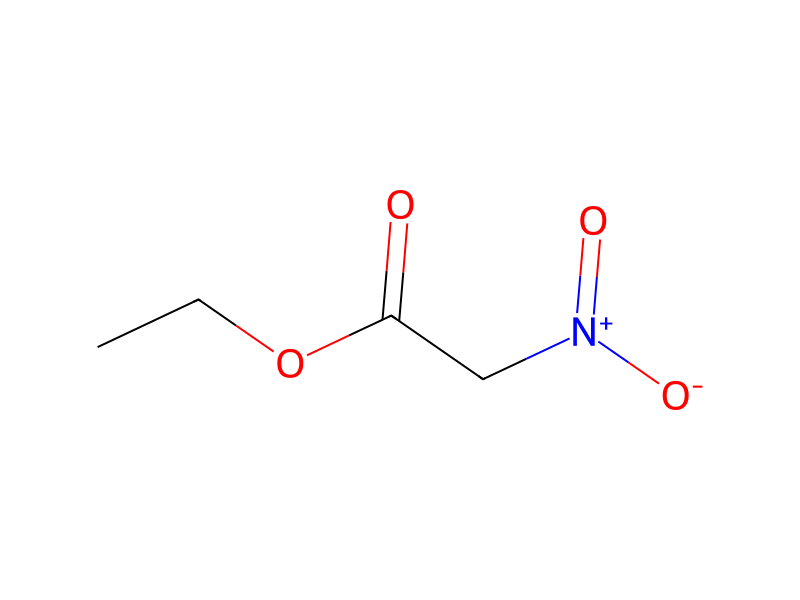
Ethyl nitroacetate → HCID 86636860, compound
Reaction equation

CN([CH2:4][C:5]1[C:13]2[C:8](=[CH:9][N:10]=[CH:11][CH:12]=2)[NH:7][C:6]=1[C:14]([O:16][CH3:17])=[O:15])C.[N+:18]([CH2:21][C:22]([O:24][CH2:25][CH3:26])=[O:23])([O-:20])=[O:19]>C1(C)C(C)=CC=CC=1>[CH3:17][O:16][C:14]([C:6]1[NH:7][C:8]2=[CH:9][N:10]=[CH:11][CH:12]=[C:13]2[C:5]=1[CH2:4][CH:21]([N+:18]([O-:20])=[O:19])[C:22]([O:24][CH2:25][CH3:26])=[O:23])=[O:15]Participants
Reactant 2

Product 1

Reagents, catalysts & solvents 1

Conditions
- Temperature
- 156 °C
Procedure
Ethyl 3-[2-(methoxycarbonyl)pyrrolo[2,3-c]pyridine-3-yl]-2-nitropropanoate (32) was synthesized according to a procedure previously published (Synthetic Commun. 1997, 27, 3201-3211). A 1 L single-necked round-bottomed flask was equipped with a magnetic bead and a reflux condenser and placed into an oil bath. The flask was charged with methyl 3-[(dimethyl amino)methyl]pyrrolo[2,3-c]pyridine-2-carboxylate (31, 8 g) and xylene (200 mL), and stirring was initiated. The solid did not dissolve in xylene and remained as a slurry. The resulting solution was degassed with nitrogen for 10 minutes. Ethyl nitroacetate (12, ˜11.4 mL) was added as a single portion to the slurry. The solution was continued to be degassed with nitrogen for a minimum of 1 h while stirring. At this stage a slight change in the nature of the slurry was observed, probably due to the formation of the gramine salt of ethyl nitroacetate. The reaction mixture was heated to reflux (˜156° C.) for 4 h. During reflux, the solid went into solution and simultaneously a white/light yellowish solid precipitated. The reaction mixture was continued to be stirred at reflux until the reaction was deemed complete, i.e., when no starting material peaks were observed on NMR. Indeed, the NMR matched with the NMR of pure product. If reaction was not complete, stirring was continued at 156° C. for another 3 h until the reaction was deemed to be complete, with additional ethyl nitroacetate added as required. This reaction was typically complete in 3-4 h. The reaction was monitored by NMR by taking an aliquot of reaction mixture (˜1 mL), cooling to room temperature, filtering through a polypad, washing with diethyl ether (˜2 mL), and submitting the solid for NMR analysis. Materials used to synthesize ethyl 3-[2-(methoxycarbonyl)pyrrolo[2,3-c]pyridine-3-yl]-2-nitropropanoate (32) are shown in Table 19.
Workup
- customA 1 L single-necked round-bottomed flask was equipped with a magnetic bead and a reflux condenser
- customplaced into an oil bath
- customThe resulting solution was degassed with nitrogen for 10 minutes
- additionEthyl nitroacetate (12, ˜11.4 mL) was added as a single portion to the slurry
- customto be degassed with nitrogen for a minimum of 1 h
- stirringwhile stirring
- temperatureThe reaction mixture was heated
- temperatureDuring reflux
- customsimultaneously a white/light yellowish solid precipitated
- stirringto be stirred
- temperatureat reflux until the reaction
- customIf reaction
- stirringstirring
- additionadded
- waitThis reaction was typically complete in 3-4 h
- temperaturecooling to room temperature
- filtrationfiltering through a polypad
- washwashing with diethyl ether (˜2 mL)
- customto synthesize ethyl 3-[2-(methoxycarbonyl)pyrrolo[2,3-c]pyridine-3-yl]-2-nitropropanoate (32)
Sources & evidence
- ORD record
- ord-8104c9691627454380a1945566e23138
- Source dataset
- uspto-grants-2012_09
- Patent number
- US08268854B2
Reaction notes
Loading…