Hydrazine → HCID 86608774, compound
Reaction equation

[F:1][C:2]1[CH:7]=[CH:6][C:5]([F:8])=[CH:4][C:3]=1[C:9]1[S:13][C:12]([CH3:20])([C:14]2[CH:19]=[CH:18][CH:17]=[CH:16][CH:15]=2)[NH:11][N:10]=1.[C:21]([N:28]1C=CN=C1)(N1C=CN=C1)=[S:22].[NH2:33]N>C1COCC1>[F:1][C:2]1[CH:7]=[CH:6][C:5]([F:8])=[CH:4][C:3]=1[C:9]1[S:13][C:12]([CH3:20])([C:14]2[CH:19]=[CH:18][CH:17]=[CH:16][CH:15]=2)[N:11]([C:21](=[S:22])[NH:28][NH2:33])[N:10]=1Participants
5
Reactant 3


Product 1

Reagents, catalysts & solvents 1

Procedure
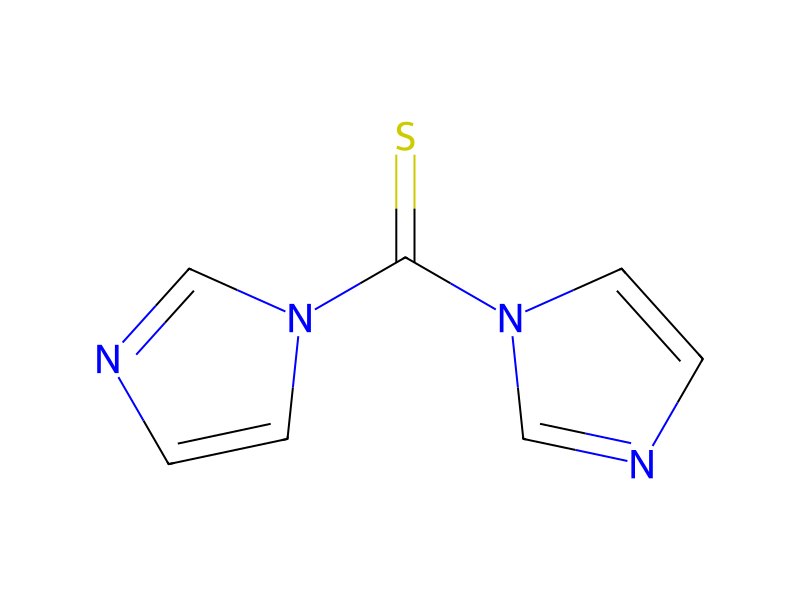
5-(2,5-difluorophenyl)-2-methyl-2-phenyl-2,3-dihydro-1,3,4-thiadiazole (0.290 g, 1.00 mmol) was weighed into a 25 mL flask, and suspended in 10 mL of anhydrous THF, followed by addition of thiocarbonyldiimidazole (0.196 g, 1.10 mmol). The reaction was then heated to reflux for 3 hours, at which time all starting material was consumed. The reaction was cooled to room temperature, followed by addition of hydrazine (0.156 mL, 5.00 mmol). Following 4 hours at room temperature, all intermediate was consumed by LC-MS. The reaction was then concentrated, then loaded to Biotage-(45) followed by flash column chromatography (10-50% ethyl acetate/hexanes), affording the desired product (80% purity; 0.268 g, 74%).
Workup
- temperatureThe reaction was then heated
- temperatureto reflux for 3 hours, at which time all starting material
- customwas consumed
- customall intermediate was consumed by LC-MS
- concentrationThe reaction was then concentrated
Sources & evidence
- ORD record
- ord-109099bbf5a8426bb5ceba54c42c05fd
- Source dataset
- uspto-grants-2012_09
- Patent number
- US08268871B2
Reaction notes
Loading…