Pyridine → HCID 58458977, compound
Reaction equation

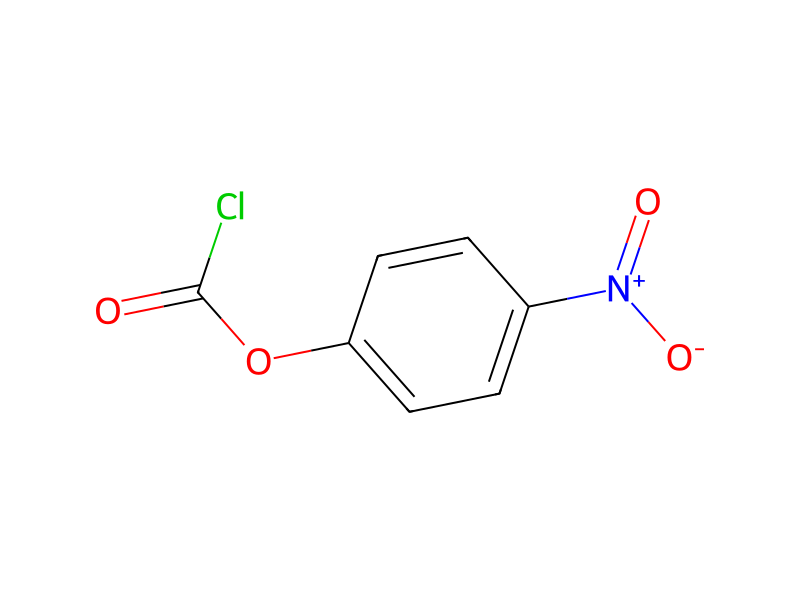
Cl[C:2]([O:4][C:5]1[CH:10]=[CH:9][C:8]([N+:11]([O-:13])=[O:12])=[CH:7][CH:6]=1)=[O:3].N1C=CC=CC=1.[CH:20]1([CH2:26][C@H:27]([OH:36])[C:28]([N:30]2[CH2:35][CH2:34][O:33][CH2:32][CH2:31]2)=[O:29])[CH2:25][CH2:24][CH2:23][CH2:22][CH2:21]1>O1CCOCC1>[C:2](=[O:3])([O:4][C:5]1[CH:6]=[CH:7][C:8]([N+:11]([O-:13])=[O:12])=[CH:9][CH:10]=1)[O:36][C@H:27]([C:28]([N:30]1[CH2:31][CH2:32][O:33][CH2:34][CH2:35]1)=[O:29])[CH2:26][CH:20]1[CH2:25][CH2:24][CH2:23][CH2:22][CH2:21]1Participants
Reactant 3


Product 1

Reagents, catalysts & solvents 1

Conditions
- Temperature
- 70 °C
Procedure
A solution of 4-nitrophenyl chloroformate (20.55 g, 102 mmol) in dioxane (150 mL) is treated with pyridine (50 mL) resulting in a suspension. This material is heated to 70° C. and a solution of 3 (12.30 g, 51.0 mmol) in dioxane (50 mL) is added via pressure equalizing dropping funnel over ˜5 minutes. After stirring for an additional 5 minutes, the reaction is allowed to cool to room temperature and the solvent is removed by rotary evaporation. The resulting mass is partitioned between ethyl acetate and water. The organic layer is collected and the aqueous phase is extracted once more with ethyl acetate and discarded. The combined organics are dried over MgSO4 and the solvent is removed. The resulting solid is dissolved in a minimal amount of hot dichloroethane and treated with dichloromethane. The mixture is then kept in a −4° C. refrigerator overnight and filtered. The mother liquor is concentrated and purified over 330 g of silica gel using a gradient of 0-100% ethyl acetate in hexane to afford 15.2 g (73% yield) of (S)-2-cyclohexyl-1-(morpholine-4-carbonyl)ethyl 4-nitro-phenyl carbonate (4) as a slightly yellow oil; 1H NMR (CDCl3, 400 MHz) δ 0.97-1.08 (m, 2H), 1.09-1.36 (m, 3H), 1.48-4.62 (m, 2H), 1.65-1.68 (m, 4H), 1.82-1.97 (m, 2H), 3.41-3.60 (m, 3H), 3.64-3.80 (m, 5H), 5.29-5.36 (m, 1H), 7.38-7.44 (m, 2H), 8.24-8.30 (m, 2H); HPLC-MS calculated for C20H26N2O7 (M+H+) 407.2, found 407.4.
Workup
- customresulting in a suspension
- customover ˜5 minutes
- temperatureto cool to room temperature
- customthe solvent is removed by rotary evaporation
- customThe resulting mass is partitioned between ethyl acetate and water
- customThe organic layer is collected
- extractionthe aqueous phase is extracted once more with ethyl acetate
- dry with materialThe combined organics are dried over MgSO4
- customthe solvent is removed
- dissolutionThe resulting solid is dissolved in a minimal amount of hot dichloroethane
- additiontreated with dichloromethane
- customis then kept in a −4° C.
- customrefrigerator overnight
- filtrationfiltered
- concentrationThe mother liquor is concentrated
- custompurified over 330 g of silica gel using a gradient of 0-100% ethyl acetate in hexane
Sources & evidence
- ORD record
- ord-63f0cf1fdc4a4a37ba0e8d47fdafdc41
- Source dataset
- uspto-grants-2012_09
- Patent number
- US08268996B2
Reaction notes
Loading…