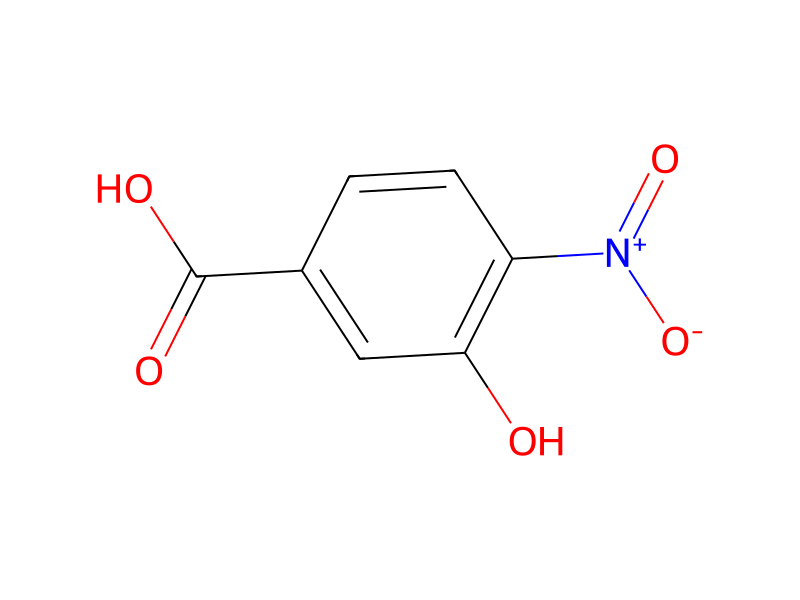
Hydrochloric Acid → Methyl 3-hydroxy-4-nitrobenzoate
Reaction equation

[OH:1][C:2]1[CH:3]=[C:4]([CH:8]=[CH:9][C:10]=1[N+:11]([O-:13])=[O:12])[C:5]([OH:7])=[O:6].Cl.[CH3:15]O>>[OH:1][C:2]1[CH:3]=[C:4]([CH:8]=[CH:9][C:10]=1[N+:11]([O-:13])=[O:12])[C:5]([O:7][CH3:15])=[O:6]Participants
4



Procedure
In a 1 liter round-bottomed flask were placed 25 g (0.14 mole) 3-hydroxy-4-nitrobenzoic acid, 37% hydrochloric acid (37 ml) and methanol (300 ml). The resulting mixture was refluxed for 10 hours. The reaction mixture was cooled to room temperature and the solvent eliminated in a rotary evaporator. The resulting residue was dissolved in ethyl acetate and washed sequentially with water (1×100 ml), aqueous sodium bicarbonate (1×100 ml), water (1×100 ml) and brine (1×100 ml). The organic layer was dried over anhydrous magnesium sulfate and solvent was removed in the rotary evaporator, yielding 22.5 g of the expected methyl 3-hydroxy-4-nitrobenzoate as a yellow solid which was used as such in the next step.
Workup
- customIn a 1 liter round-bottomed flask were placed
- temperatureThe resulting mixture was refluxed for 10 hours
- customthe solvent eliminated in a rotary evaporator
- dissolutionThe resulting residue was dissolved in ethyl acetate
- washwashed sequentially with water (1×100 ml), aqueous sodium bicarbonate (1×100 ml), water (1×100 ml) and brine (1×100 ml)
- dry with materialThe organic layer was dried over anhydrous magnesium sulfate and solvent
- customwas removed in the rotary evaporator
Sources & evidence
- ORD record
- ord-036caa3cb94e4dd09b47890d7cf767c8
- Source dataset
- uspto-grants-1998_09
- Patent number
- US05811427
Reaction notes
Loading…