m-Chloroperbenzoic acid → 3-Chlorobenzoic Acid
Reaction equation

[CH:1]1[CH:6]=[C:5]([Cl:7])[CH:4]=[C:3]([C:8]([O:10]O)=[O:9])[CH:2]=1>ClCCl>[Cl:7][C:5]1[CH:4]=[C:3]([CH:2]=[CH:1][CH:6]=1)[C:8]([OH:10])=[O:9]Participants
Reactant 1

Product 1
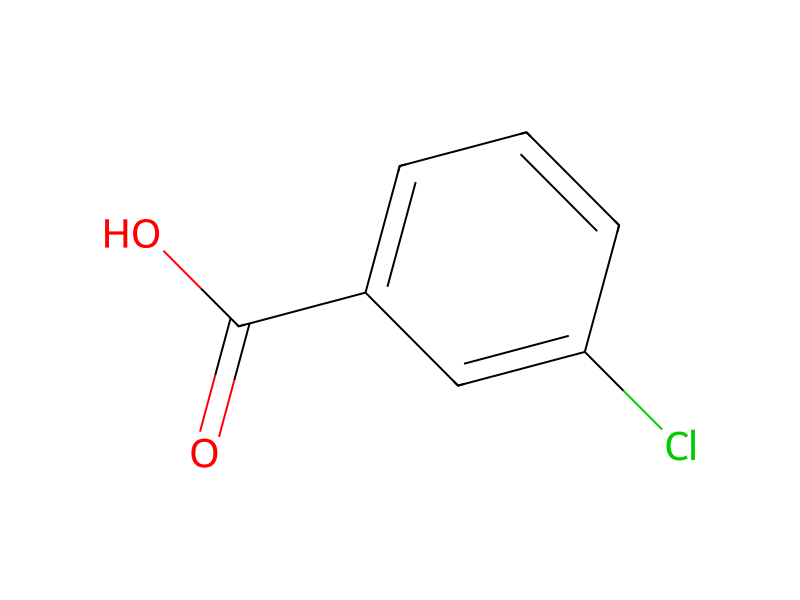
Reagents, catalysts & solvents 1

Procedure
A 500 mL three neck flask equipped with a stirrer, thermometer, condenser and 200 mL additional funnel was charged with 10 g (0.0151 mol) of Twin 9a and 100 mL of dichloromethane. The stirrer was started, and the temperature was lowered to 0° C. with an ice bath. 15.59 g (0.0904 mol) of MCPBA was dissolved in 150 mL of dichloromethane and added dropwise over a 30 minute period to the Twin 9a solution. The solution was allowed to warm to room temperature. Stirring continued for 12 hours at room temperature. During the reaction, a precipitate (3-chlorobenzoic acid) formed. The reaction mixture was filtered and the filtrate was washed with 500 mL of 5% sodium bisulfite to destroy residual peracid, and next with 500 mL of 2.5% sodium bicarbonate to extract 3-chlorobenzoic acid. Finally, it was washed with 500 mL of saturated aqueous sodium chloride and then dried over magnesium sulfite. The solvent was removed under reduced pressure to yield a pale yellow solid. The solid was recrystallized from 200 mL of 70/30 ethyl acetate/2-propanol to yield after vacuum drying 6.98 g of white crystals. 1HNMR (CDCl3, 23° C.): δ 8.1 (4H, d, aromatic), 6.9-7.1 (12H, m, aromatic), 4.3-4.4 (2H, d, CH glycidyl), 4.0-4.1 (2H, d, CH glycidyl), 3.9-4.0 (4H, m, CH2 octyl), 3.3-3.4 (2H, m, CH2 glycidyl), 2.9-3.0 (2H, t, CH glycidyl), 2.8 (2H, t, CH glycidyl), 1.7-1.9 (4H, m, CH2 octyl), 1.3-1.6 (8H, m, CH2 octyl).
Workup
- customthe temperature was lowered to 0° C. with an ice bath
- customDuring the reaction
Sources & evidence
- ORD record
- ord-2c77b0142654418f8686458dd0ed6a9d
- Source dataset
- uspto-grants-1998_09
- Patent number
- US05811504
Reaction notes
Loading…