Phosphorus pentachloride → Linoleoyl chloride
Reaction equation

[C:1]([OH:20])(=O)[CH2:2][CH2:3][CH2:4][CH2:5][CH2:6][CH2:7][CH2:8]/[CH:9]=[CH:10]\[CH2:11]/[CH:12]=[CH:13]\[CH2:14][CH2:15][CH2:16][CH2:17][CH3:18].P(Cl)(Cl)(Cl)(Cl)[Cl:22]>C1C=CC=CC=1>[C:1]([Cl:22])(=[O:20])[CH2:2][CH2:3][CH2:4][CH2:5][CH2:6][CH2:7][CH2:8]/[CH:9]=[CH:10]\[CH2:11]/[CH:12]=[CH:13]\[CH2:14][CH2:15][CH2:16][CH2:17][CH3:18]Participants
4
Reactant 2

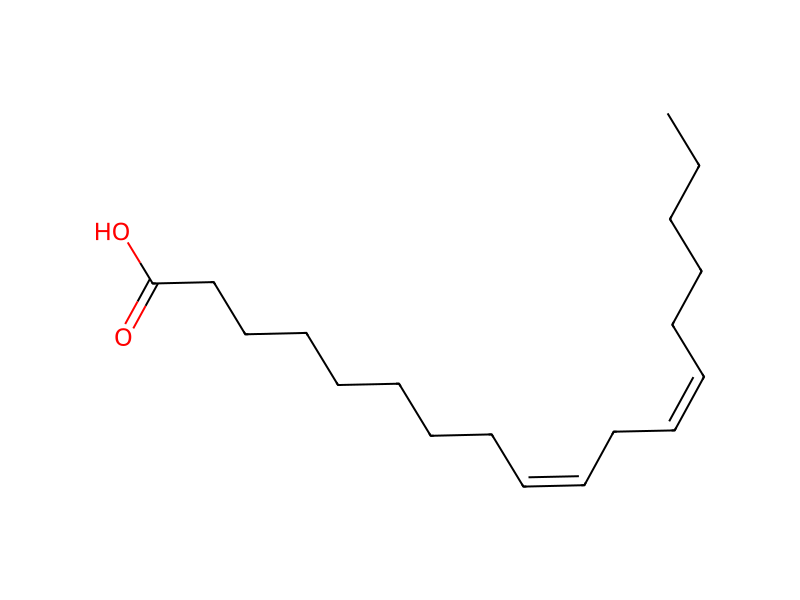
Product 1

Reagents, catalysts & solvents 1

Procedure
A solution of 20.0 g of linolic acid in 70 ml of dry benzene was placed in a flask and kept swept therein with nitrogen for displacement of the entrapped air and 14.8 g of phosphorus pentachloride was added meanwhile thereto as divided in five split portions. The resultant reaction mixture was stirred at normal room temperature for 12 hours and then refluxed for two hours. Then, the reaction solution was distilled to expel benzene and the products of a secondary reaction, i.e. phosphoryl trichloride and hydrogen chloride and the residue was subjected to vacuum distillation to produce 14.0 g of linolic acid chloride (boiling point 155° C./1.5 mmHg; yield 76%).
Workup
- customsplit portions
- customThe resultant reaction mixture
- temperaturerefluxed for two hours
- distillationThen, the reaction solution was distilled
- customthe products of a secondary reaction, i.e. phosphoryl trichloride and hydrogen chloride
- distillationthe residue was subjected to vacuum distillation
Sources & evidence
- ORD record
- ord-b37f93eeb6b6472d8b97733e90652630
- Source dataset
- uspto-grants-1996_02
- Patent number
- US05489303
Reaction notes
Loading…