4-Hydroxybenzoic Acid → 4-(4,5-Dihydro-1,3-oxazol-2-yl)phenol
Reaction equation

[OH:1][C:2]1[CH:10]=[CH:9][C:5]([C:6]([OH:8])=O)=[CH:4][CH:3]=1.[CH2:11]([CH2:13][NH2:14])O.C(Cl)(Cl)Cl.S(Cl)(Cl)=O>C(OCC)(=O)C>[OH:1][C:2]1[CH:3]=[CH:4][C:5]([C:6]2[O:8][CH2:11][CH2:13][N:14]=2)=[CH:9][CH:10]=1Participants
Reactant 4
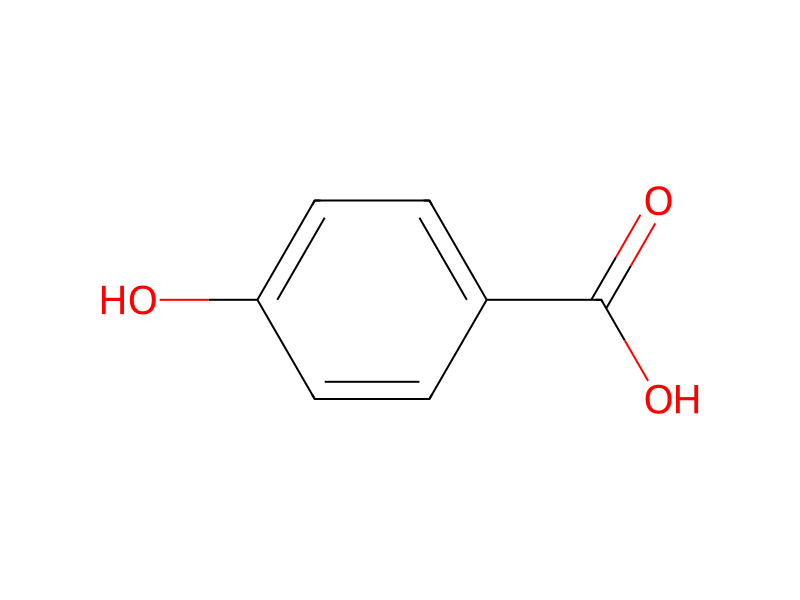



Product 1

Reagents, catalysts & solvents 1

Conditions
- Temperature
- 60 °C
Procedure
Phenyl ester of 4-hydroxybenzoic acid (19.28 grams, 0.09 mole) and monoethanolamine (5.55 grams, 0.0909 mole) are added to a reactor and stirred as a powder under a nitrogen atmosphere. Heating commences and fourteen minutes later, a temperature of 150° C. is achieved. After 108 minutes at 150° C., the reactor is cooled to 60° C., then chloroform (100 milliliters) is added. After boiling for 5 minutes, the chloroform is decanted off, and a second portion (100 milliliters) of chloroform is added. After boiling for 5 minutes, the chloroform is again removed by decantation. A third portion (100 milliliters) of chloroform is added followed by boiling for 5 minutes and decantation. Ethyl acetate (100 grams) is added to the powder product remaining in the reactor and stirring under a nitrogen atmosphere commences to provide a fine slurry. Thionyl chloride (21.41 grams, 0.18 mole) dissolved in ethyl acetate (50 grams) is added to the reactor inducing an exotherm to 29° C. three minutes later. The reactor is allowed to cool to 25° C. and maintained therein for 237 minutes. The product is filtered off and the product recovered on the filter is washed with two portions (50 milliliters) of ethyl acetate. The filter cake of N-(2-chloroethyl)-4-hydroxybenzamide slightly damp with ethyl acetate is added to a beaker containing deionized water (300 milliliters) and stirred to a solution. Five percent aqueous sodium hydroxide solution is added dropwise to the solution until the pH reached 7. At this time, a white slurry of crystalline product is formed and is stirred for an additional ten minutes before filtration. The product is washed on the filter with two portions (50 milliliters) of deionized water, removed, added to a porcelain dish and then dried in a vacuum oven at 50° C. and 1 mm Hg for two hours. After this time, the product is removed and boiled in acetone (300 milliliters). After cooling to 25° C., 200 milliliters of the acetone is removed by rotary evaporation. The resulting product is recovered by filtration, washed on the filter with cold acetone (25 milliliters), removed, added to a porcelain dish and then dried in a vacuum oven at 50° C. and 1 mm Hg to a constant weight of 9.02 grams of crystalline white powder. Fourier transform infrared spectrophotometric analysis of a potassium bromide pellet of the product reveals the presence of the expected oxazoline >C=N-- absorbance at 1636 cm-1, the hydroxyl group O--H stretching at 3442 cm-1 and the out-of-plane C--H bending vibration at 839 cm-1 indicative of para-disubstitution. An absorption characteristic of the oxazoline ring is observed at 945 cm-1. Proton magnetic resonance spectroscopy (250 MHz) further confirms the product structure as the 2-(4-hydroxyphenyl)oxazoline.
Workup
- customHeating commences and fourteen minutes
- customa temperature of 150° C.
- waitAfter boiling for 5 minutes
- customthe chloroform is decanted off
- additiona second portion (100 milliliters) of chloroform is added
- waitAfter boiling for 5 minutes
- customthe chloroform is again removed by decantation
- additionA third portion (100 milliliters) of chloroform is added
- waitby boiling for 5 minutes
- additionEthyl acetate (100 grams) is added to the powder product
- stirringstirring under a nitrogen atmosphere commences
- customto provide a fine slurry
- additionis added to the reactor
- customto 29° C.
- customthree minutes
- temperatureto cool to 25° C.
- temperaturemaintained
- waitfor 237 minutes
- filtrationThe product is filtered off
- customthe product recovered on the filter
- washis washed with two portions (50 milliliters) of ethyl acetate
- additionis added to a beaker
- additioncontaining deionized water (300 milliliters)
- stirringstirred to a solution
- additionFive percent aqueous sodium hydroxide solution is added dropwise to the solution until the pH
- customAt this time, a white slurry of crystalline product is formed
- stirringis stirred for an additional ten minutes before filtration
- washThe product is washed on the
- filtrationfilter with two portions (50 milliliters) of deionized water
- customremoved
- additionadded to a porcelain dish
- customdried in a vacuum oven at 50° C.
- wait1 mm Hg for two hours
- customAfter this time, the product is removed
- temperatureAfter cooling to 25° C.
- custom200 milliliters of the acetone is removed by rotary evaporation
- filtrationThe resulting product is recovered by filtration
- washwashed on the
- filtrationfilter with cold acetone (25 milliliters)
- customremoved
- additionadded to a porcelain dish
- customdried in a vacuum oven at 50° C.
Sources & evidence
- ORD record
- ord-d6d452cf32f44eb3b4f9cf922f560a37
- Source dataset
- uspto-grants-1996_02
- Patent number
- US05491201
Reaction notes
Loading…