Adipic Acid → Adipic Acid
反応式

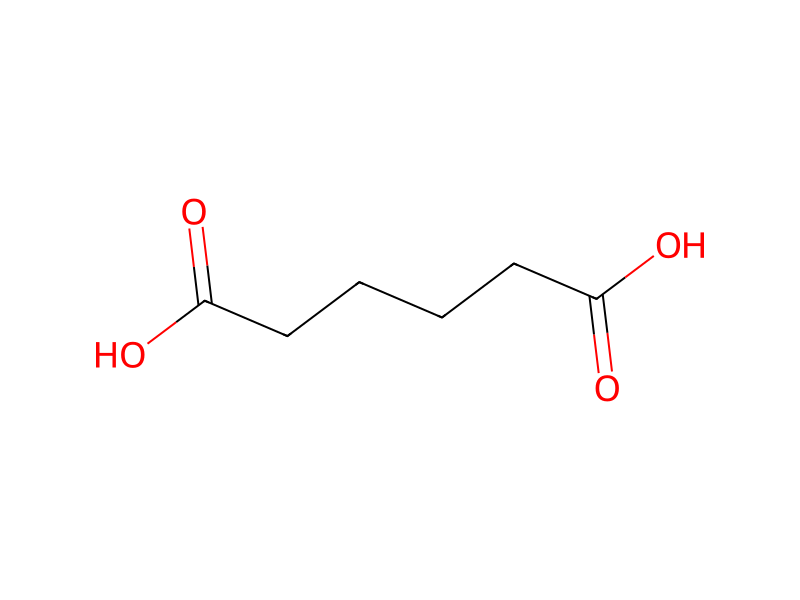
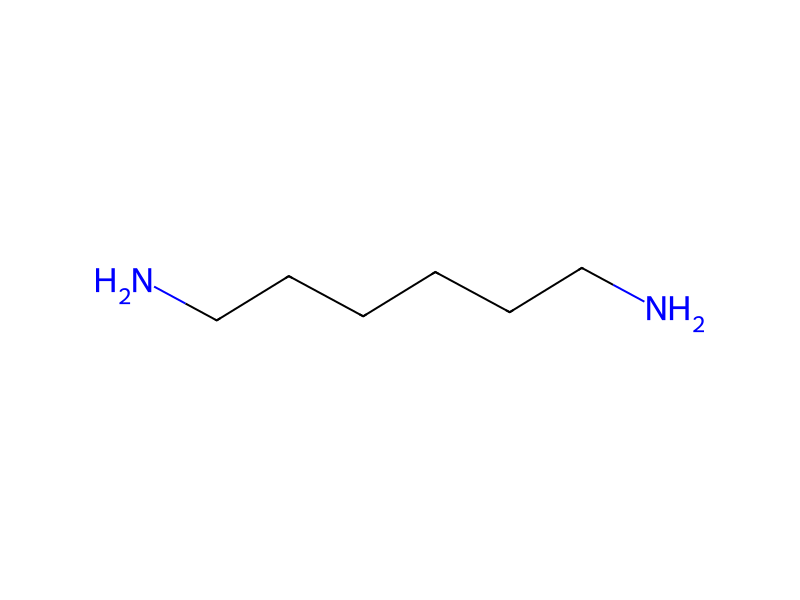
C1(CN)(CN)CCCCC1.[CH:11]1([CH2:19][NH2:20])CC[CH:14]([CH2:17][NH2:18])[CH2:13][CH2:12]1.[C@H]1(CN)CC[C@H](CN)CC1.[C:31]([OH:40])(=[O:39])[CH2:32][CH2:33][CH2:34][CH2:35][C:36]([OH:38])=[O:37]>>[NH2:18][CH2:17][CH2:14][CH2:13][CH2:12][CH2:11][CH2:19][NH2:20].[C:31]([OH:40])(=[O:39])[CH2:32][CH2:33][CH2:34][CH2:35][C:36]([OH:38])=[O:37]参加物


実験手順
Polyamides derived from cyclohexanebis (methylamine) are known in the prior art. In U.S. Pat. No. 3,012,994 polyamides derived from the condensation of 1,3- or 1,4-cyclohexanebis(methylamine) and a dicarboxylic acid are described. These polyamides possess good stability and strength properties and are described as having relatively high melting points; for example, the polyamide of trans-1, 4cyclohexane-bis(methylamine) and adipic acid has a crystalline melting point of 345° C., whereas nylon 66 formed from hexamethylene diamine and adipic acid has a melting point of only 264° C. However, the high melting point advantage of these polyamides also gives rise to certain inherent disadvantages. For example, polyamides having crystalline melting points much above about 300° C. tend to decompose into degradation products prior to melting. As a result filaments formed from these high melting polyamides generally have poor processability and inferior properties. Although lower melting polyamides can be obtained with trans-1,4cyclohexanebis(methylamine) by condensation with longer chain carboxylic acids, the use of the longer chain acids results in a decrease in the dimensional stability of the resulting polyamide. An object of the present invention is to provide polyamides derived from components comprising a cyclohexanebis(alkylamine) which have good dimensional stability and which have substantially lower melting points than the corresponding polyamides derived from cyclohexanebis(methylamine).
出典と根拠
- ORDレコード
- ord-63ca0a3e22004274b8c82bd15d82b4c5
- 出典データセット
- uspto-grants-1977_05
- 特許番号
- US04024114
反応ノート
読み込み中…