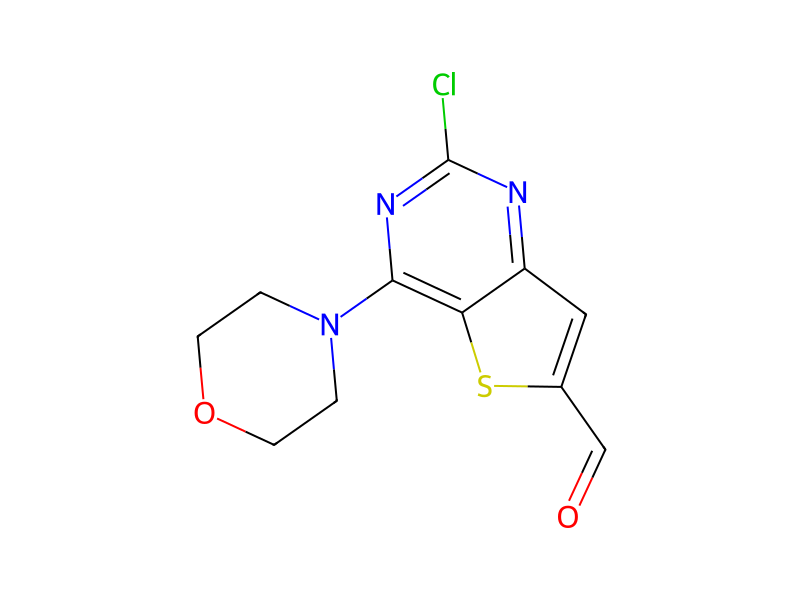
Acetic Acid → 1-(2-Chloro-4-morpholinothieno[3,2-d]pyrimidin-6-yl)-N-methylmethanamine
Reaction equation

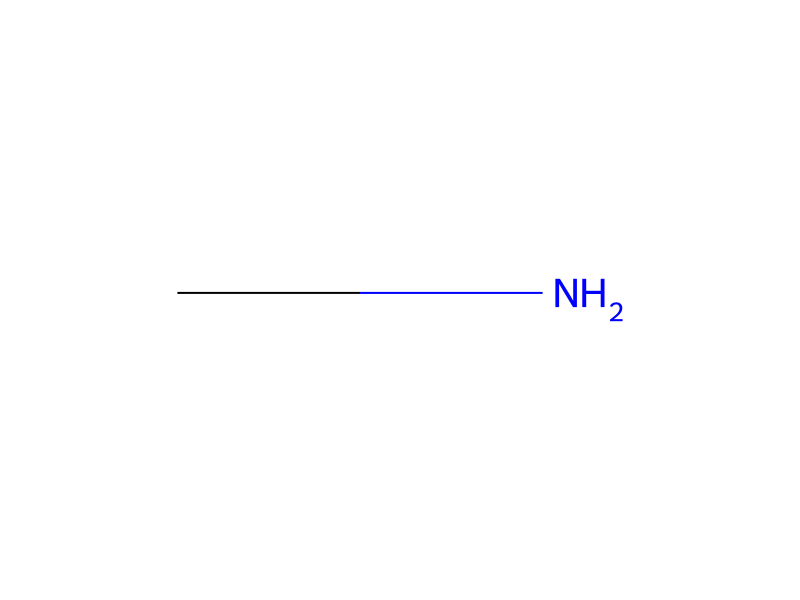
[Cl:1][C:2]1[N:3]=[C:4]([N:13]2[CH2:18][CH2:17][O:16][CH2:15][CH2:14]2)[C:5]2[S:10][C:9]([CH:11]=O)=[CH:8][C:6]=2[N:7]=1.C(O)(=O)C.[CH3:23][NH2:24].[BH4-].[Na+]>CO>[Cl:1][C:2]1[N:3]=[C:4]([N:13]2[CH2:18][CH2:17][O:16][CH2:15][CH2:14]2)[C:5]2[S:10][C:9]([CH2:11][NH:24][CH3:23])=[CH:8][C:6]=2[N:7]=1Participants
Reactant 4


Product 1

Reagents, catalysts & solvents 1

Procedure
To a suspension of 2-chloro-4-morpholin-4-yl-thieno[3,2-d]pyrimidine-6-carbaldehyde (1.0 g) and molecular sieves in methanol (20 mL) at room temperature was added acetic acid (0.1 mL) and a solution of methylamine (219 mg) in methanol (1 ml). The reaction mixture was stirred at room temperature for 24 h. Then sodium borohydride (542 mg) was added portionwise and the reaction stirred at room temperature for a further 30 min. The reaction was then quenched with saturated aqueous sodium hydrogen carbonate solution (10 mL) and extracted into dichloromethane (2×10 mL). The combined organics were washed with brine (20 mL), dried (MgSO4) and reduced in vacuo to give (2-chloro-4-morpholin-4-yl-thieno[3,2-d]pyrimidin-6-ylmethyl)-methyl-amine as a white solid (0.95 g).
Workup
- stirringthe reaction stirred at room temperature for a further 30 min
- customThe reaction was then quenched with saturated aqueous sodium hydrogen carbonate solution (10 mL)
- extractionextracted into dichloromethane (2×10 mL)
- washThe combined organics were washed with brine (20 mL)
- dry with materialdried (MgSO4)
Sources & evidence
- ORD record
- ord-f4979fda90e64197be5a10c9c4aaa507
- Source dataset
- uspto-grants-2014_08
- Patent number
- US08802670B2
Reaction notes
Loading…