Water → Cyclopropyl(4-nitrophenyl)sulfane
Reaction equation

[CH:1]1([SH:4])[CH2:3][CH2:2]1.[H-].[Na+].F[C:8]1[CH:13]=[CH:12][C:11]([N+:14]([O-:16])=[O:15])=[CH:10][CH:9]=1.O>C1COCC1.C(OCC)C>[CH:1]1([S:4][C:8]2[CH:13]=[CH:12][C:11]([N+:14]([O-:16])=[O:15])=[CH:10][CH:9]=2)[CH2:3][CH2:2]1Participants
6
Reactant 4

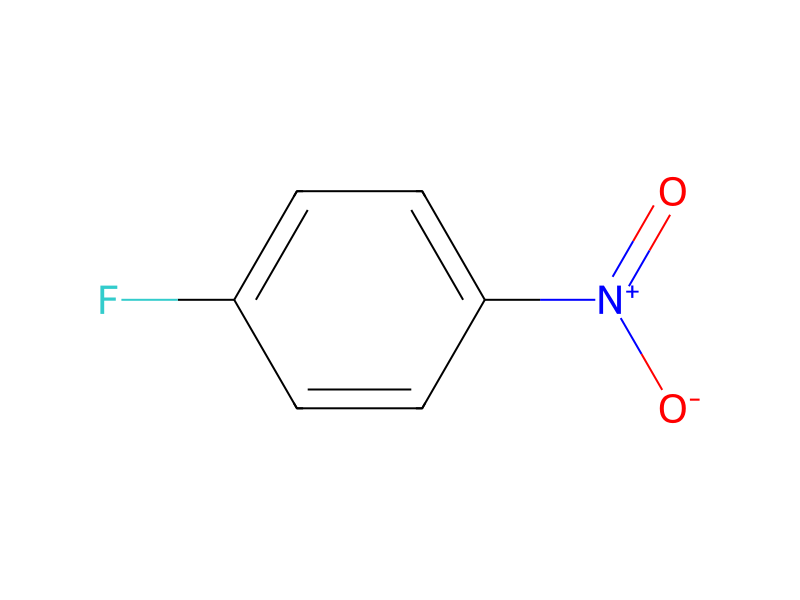


Product 1

Reagents, catalysts & solvents 1

Procedure
A 4% strength solution of 3.00 g (40.5 mmol) of cyclopropanethiol (preparation according to: E. Block et al., J. Am. Chem. Soc. 1992, 114, 3492) in THF/diethyl ether (1:1) was admixed in portions with 1.78 g (44.6 mmol) of sodium hydride (60%) and stirred for 30 minutes at room temperature. The portionwise addition of 6.00 g (38.7 mmol) of 1-fluoro-4-nitrobenzene was then carried out. The mixture was stirred at 40° C. for 2 hours. After cooling, the mixture was added to water and extracted (3×) with benzene. The combined organic phases were concentrated by evaporation and the residue was purified chromatographically (hexane/ethyl acetate 95:5). This gave 4.6 g (23.6 mmol; yield: 61%) of the product.
Workup
- stirringThe mixture was stirred at 40° C. for 2 hours
- temperatureAfter cooling
- extractionextracted (3×) with benzene
- concentrationThe combined organic phases were concentrated by evaporation
- customthe residue was purified chromatographically (hexane/ethyl acetate 95:5)
Sources & evidence
- ORD record
- ord-815fa7ceaed34a02bd7fe91b638dd6d0
- Source dataset
- uspto-grants-2014_08
- Patent number
- US08802686B2
Reaction notes
Loading…