Sodium Carbonate → 4-Bromo-4'-(trifluoromethyl)biphenyl
Reaction equation

[F:1][C:2]([F:13])([F:12])[C:3]1[CH:8]=[CH:7][C:6](B(O)O)=[CH:5][CH:4]=1.[Br:14][C:15]1[CH:20]=[CH:19][C:18](I)=[CH:17][CH:16]=1.C(=O)([O-])[O-].[Na+].[Na+]>CC([O-])=O.CC([O-])=O.[Pd+2]>[Br:14][C:15]1[CH:20]=[CH:19][C:18]([C:6]2[CH:7]=[CH:8][C:3]([C:2]([F:13])([F:12])[F:1])=[CH:4][CH:5]=2)=[CH:17][CH:16]=1Participants


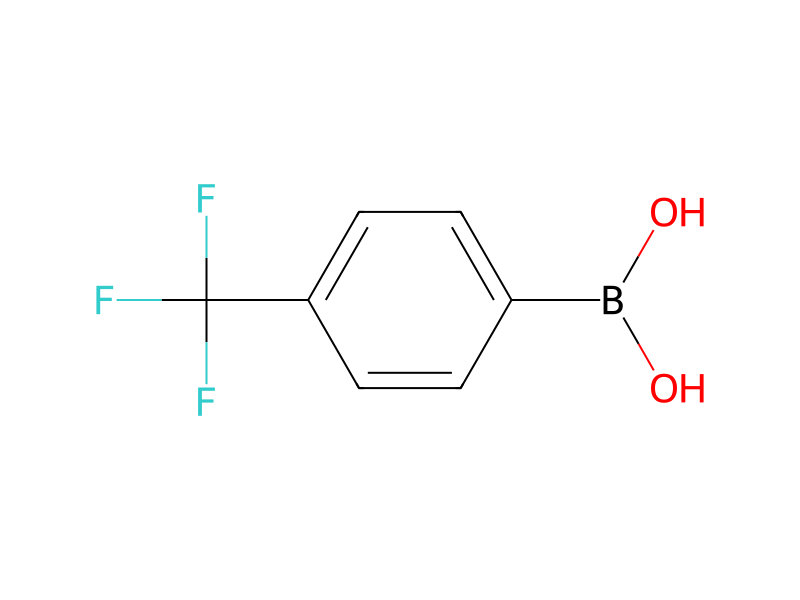


Conditions
- Temperature
- 100 °C
Procedure
A 250 mL flask was charged with 4-(trifluoromethyl)phenylboronic acid (4.85 g, 25.5 mmol), 4-bromoiodobenzene (7.22 g, 25.5 mmol), Pd(OAc)2 (57.2 mg, 0.255 mmol) and sodium carbonate (5.41 g, 51.0 mmol). The flask was flushed with nitrogen, then n-propanol (40 mL) and water (8 mL) were added. The mixture was stirred at 100° C. overnight. The reaction mixture was cooled to room temperature and diluted with water. The mixture was extracted with ethyl acetate. The organic layer was washed with brine, dried over Na2SO4, and concentrated under reduced pressure. The crude residue was purified by silica gel chromatography to provide 4-bromo-4′-(trifluoromethyl)biphenyl (5.4 g, 70%) as a colorless solid. 1H NMR (400 MHz, CDCl3) δ 7.62-7.73 (m, 4H), 7.57-7.61 (m, 2H), 7.43-7.47 (m, 2H).
Workup
- customThe flask was flushed with nitrogen
- additionn-propanol (40 mL) and water (8 mL) were added
- temperatureThe reaction mixture was cooled to room temperature
- additiondiluted with water
- extractionThe mixture was extracted with ethyl acetate
- washThe organic layer was washed with brine
- dry with materialdried over Na2SO4
- concentrationconcentrated under reduced pressure
- customThe crude residue was purified by silica gel chromatography
Sources & evidence
- ORD record
- ord-5de950b344fa4ea88bfc40e18801b422
- Source dataset
- uspto-grants-2014_08
- Patent number
- US08809342B2
Reaction notes
Loading…