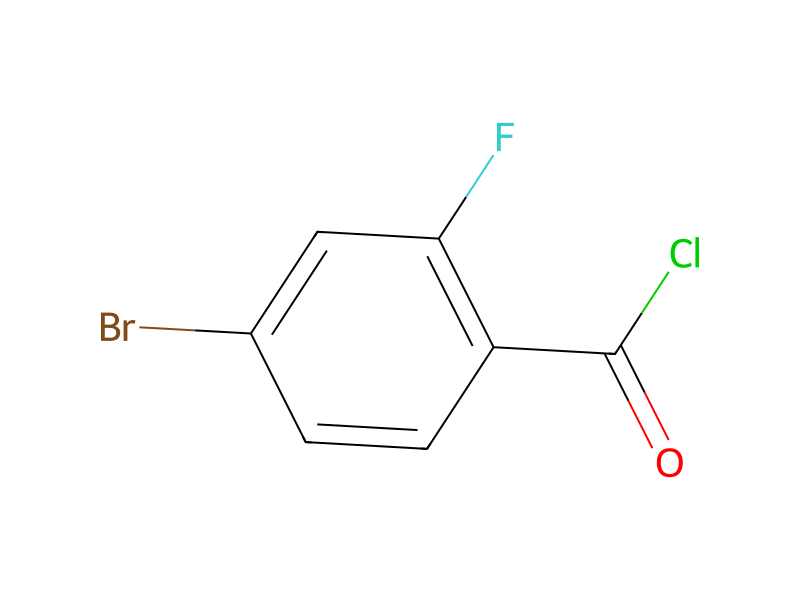
4-Bromo-2-fluorobenzoyl chloride → (4-Bromo-2-fluorophenyl)[4-(3-cyclopropyl-5-methylpyridin-2-yl)piperazin-1-yl]methanone
Reaction equation

[Br:1][C:2]1[CH:10]=[CH:9][C:5]([C:6](Cl)=[O:7])=[C:4]([F:11])[CH:3]=1.Cl.[CH:13]1([C:16]2[C:17]([N:23]3[CH2:28][CH2:27][NH:26][CH2:25][CH2:24]3)=[N:18][CH:19]=[C:20]([CH3:22])[CH:21]=2)[CH2:15][CH2:14]1>>[Br:1][C:2]1[CH:10]=[CH:9][C:5]([C:6]([N:26]2[CH2:27][CH2:28][N:23]([C:17]3[C:16]([CH:13]4[CH2:15][CH2:14]4)=[CH:21][C:20]([CH3:22])=[CH:19][N:18]=3)[CH2:24][CH2:25]2)=[O:7])=[C:4]([F:11])[CH:3]=1Participants
3


Procedure
Using 4-bromo-2-fluorobenzoyl chloride (2.6 g) and 1-(3-cyclopropyl-5-methylpyridin-2-yl)piperazine hydrochloride (2.8 g) described in Preparation Example 85 and by the reaction and treatment in the same manner as in Preparation Example 108, the title compound (2.5 g) was obtained.
Workup
- customdescribed in Preparation Example 85 and by the reaction and treatment in the same manner as in Preparation Example 108
Sources & evidence
- ORD record
- ord-7789bbada3d04b09b9203c0f7b0aeab7
- Source dataset
- uspto-grants-2014_08
- Patent number
- US08816079B2
Reaction notes
Loading…