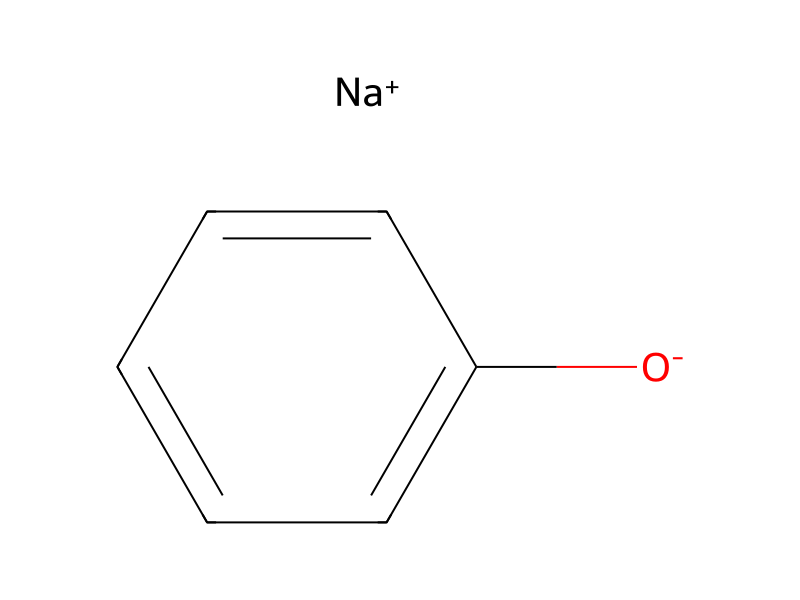
Phenolate Sodium → 1-Chloro-2-(1-ethylcyclopentyl)-2-phenoxyethylene
Reaction equation

[C:1]1([O-:7])[CH:6]=[CH:5][CH:4]=[CH:3][CH:2]=1.[Na+].[Cl:9][C:10](Cl)=[CH:11][C:12]1([CH2:17][CH3:18])[CH2:16][CH2:15][CH2:14][CH2:13]1>CN1CCCC1=O.C(Cl)Cl>[Cl:9][CH:10]=[C:11]([C:12]1([CH2:17][CH3:18])[CH2:16][CH2:15][CH2:14][CH2:13]1)[O:7][C:1]1[CH:6]=[CH:5][CH:4]=[CH:3][CH:2]=1Participants
5




Conditions
- Temperature
- 210 °C
Procedure
140 g (4.2 mol) of sodium phenolate in 500 ml of N-methylpyrrolidone were heated to 200° C. 116 g (0.6 mol) of 1-(2,2-dichlorovinyl)-1-ethyl-cyclopentane were added dropwise so slowly that the reaction temperature did not fall below 195° C. The mixture was then stirred for a further hour at 210° C. After the mixture had cooled, it was diluted with methylene chloride and extracted several times by shaking with 2 N sodium hydroxide solution. The organic phase, which had been dried over sodium sulphate, was concentrated in vacuo, and the residue was fractionated. 132 g (88% of theory) of 1-chloro-2-(1-ethylcyclopentyl)-2-phenoxyethylene of boiling point 115° to 125° C./0.1 mm Hg were obtained.
Workup
- customdid not fall below 195° C
- temperatureAfter the mixture had cooled
- extractionextracted several times
- stirringby shaking with 2 N sodium hydroxide solution
- dry with materialThe organic phase, which had been dried over sodium sulphate
- concentrationwas concentrated in vacuo
Sources & evidence
- ORD record
- ord-cdd9219842f74d67b6cbee070dff4dab
- Source dataset
- uspto-grants-1985_01
- Patent number
- US04492795
Reaction notes
Loading…