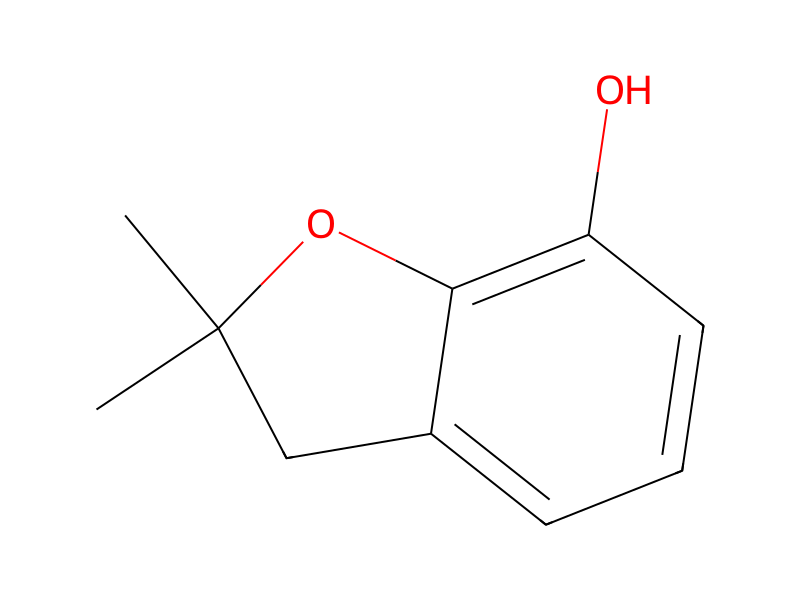
Catechol → 2,3-Dihydro-2,2-dimethyl-7-benzofuranol
Reaction equation

[C:1]1([C:3](=[CH:5][CH:6]=[CH:7][CH:8]=1)[OH:4])[OH:2].Cl[CH2:10][C:11]([CH3:13])=[CH2:12].[OH-].[Na+].COS([O:21][CH3:22])(=O)=O>O>[CH3:10][C:11]1([CH3:13])[CH2:12][C:8]2[CH:7]=[CH:6][CH:5]=[C:3]([OH:4])[C:1]=2[O:2]1.[CH3:12][C:11]1([CH3:13])[CH2:10][C:8]2[CH:7]=[CH:6][CH:5]=[C:3]([O:21][CH3:22])[C:1]=2[O:2]1Participants
7





Procedure
The starting material 2,3-dihydro-2,2-dimethyl-7-benzofuranol is prepared from catechol and 3-chloro-2-methylpropene as described by Neth. No. 6,500,340. The material (16.4 g) is added to 125 ml of water and contacted with 8 ml of 50% NaOH. After stirring one-half hour, 16.4 g of dimethylsulfate is added and the resulting suspension is stirred and heated at 60° for 2 hours. The resulting mixture is extracted with methylene chloride. The organic phase is dried over sodium sulfate and the solvent is evaporated under reduced pressure. The residual oil is distilled to afford 2,3-dihydro-2,2-dimethyl-7-methoxybenzofuran.
Workup
- stirringthe resulting suspension is stirred
- temperatureheated at 60° for 2 hours
- extractionThe resulting mixture is extracted with methylene chloride
- dry with materialThe organic phase is dried over sodium sulfate
- customthe solvent is evaporated under reduced pressure
- distillationThe residual oil is distilled
Sources & evidence
- ORD record
- ord-9046a6d532004c24910c15a895541ff3
- Source dataset
- uspto-grants-1985_01
- Patent number
- US04494979
Reaction notes
Loading…