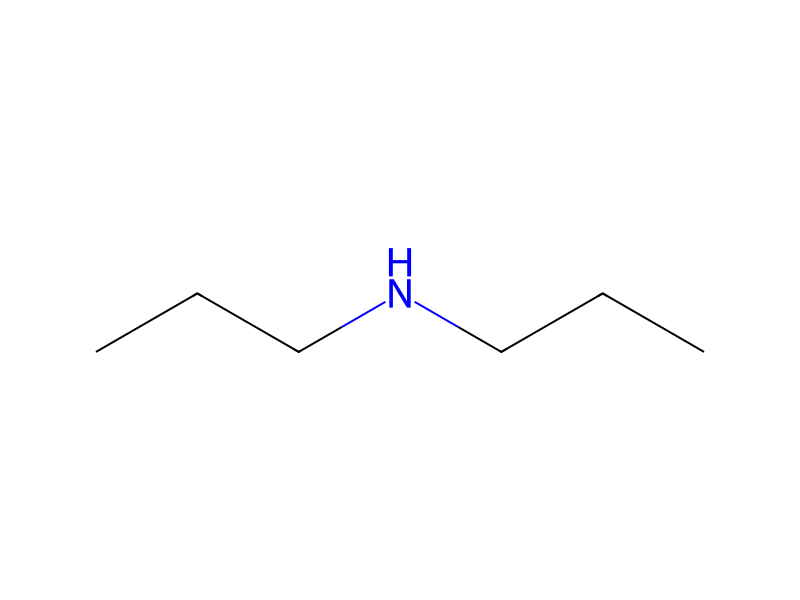
Dipropylamine → 4-Di-n-propylamino-[1,2,4]triazolo[4,3-a]quinoxaline
Reaction equation

Cl[C:2]1[C:3]2[N:4]([CH:12]=[N:13][N:14]=2)[C:5]2[C:10]([N:11]=1)=[CH:9][CH:8]=[CH:7][CH:6]=2.[CH2:15]([NH:18][CH2:19][CH2:20][CH3:21])[CH2:16][CH3:17]>CN(C)C=O>[CH2:15]([N:18]([CH2:19][CH2:20][CH3:21])[C:2]1[C:3]2[N:4]([CH:12]=[N:13][N:14]=2)[C:5]2[C:10]([N:11]=1)=[CH:9][CH:8]=[CH:7][CH:6]=2)[CH2:16][CH3:17]Participants
4
Reactant 2

Product 1

Reagents, catalysts & solvents 1

Procedure
4-Chloro-[1,2,4]triazolo[4,3-a]-quinoxaline (2.0 g., 0.01 mole), the product of Example 2, and 3.0 g. (0.03 mole) of di-n-propylamine in N,N-dimethylformamide (50 ml.) were stirred for 3 hours at room temperature. The solution was poured over ice to form a precipitate which was separated by filtration and air dried. Recrystallization from cyclohexane (250 ml.) afforded 1.1 g. (41% yield) of 4-di-n-propylamino-[1,2,4]triazolo[4,3-a]quinoxaline, m.p. 240°-242° C. Mass spectrum: m/e, 269 (P).
Workup
- additionThe solution was poured over ice
- customto form a precipitate which
- customwas separated by filtration and air
- customdried
- customRecrystallization from cyclohexane (250 ml.)
- customafforded 1.1 g
Sources & evidence
- ORD record
- ord-d67475b1a815489a815f64b1a0883068
- Source dataset
- uspto-grants-1985_01
- Patent number
- US04495187
Reaction notes
Loading…