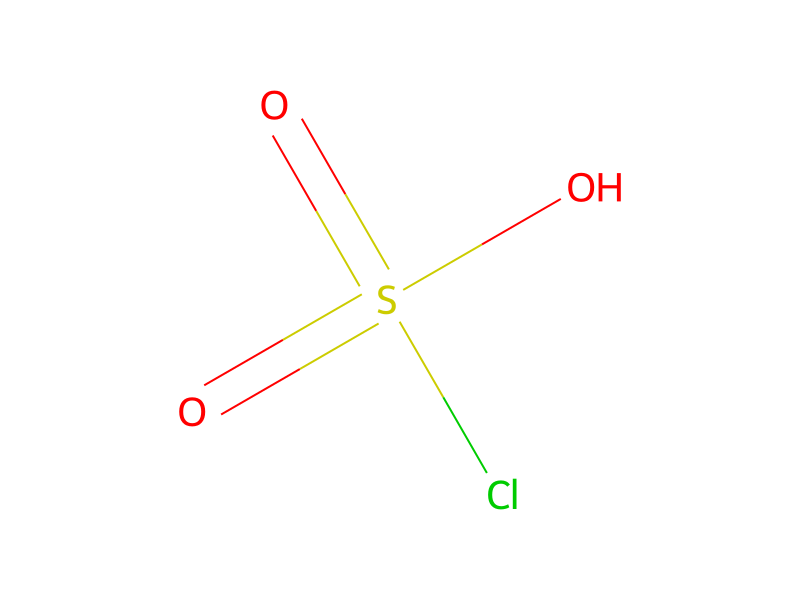
Chlorosulfonic acid → HCID 42633764, compound
Reaction equation

[Cl:1][S:2]([OH:5])(=O)=[O:3].[CH3:6][C:7]1[CH:12]=[CH:11][C:10]([N:13]2[CH:17]=[N:16][C:15]([C:18]([F:21])([F:20])[F:19])=[N:14]2)=[C:9]([CH3:22])[CH:8]=1>C(OCC)(=O)C>[CH3:6][C:7]1[CH:8]=[C:9]([CH3:22])[C:10]([N:13]2[CH:17]=[N:16][C:15]([C:18]([F:20])([F:21])[F:19])=[N:14]2)=[CH:11][C:12]=1[S:2]([Cl:1])(=[O:5])=[O:3]Participants
4
Reactant 2

Product 1

Reagents, catalysts & solvents 1

Conditions
- Temperature
- 70 °C
Procedure
In a 25-ml eggplant flask provided with a magnetic stirrer were placed 2.5 g (22 mol) of chlorosulfonic acid and then 1.8 g (7.4 mmol) of 1,3-dimethyl-4-(3-trifluoromethyl-1H-1,2,4-triazol-1-yl)benzene. The mixture was stirred at 70° C. for 2 hours. The mixture was cooled to room temperature and then added onto ice in small portions. Thereto was added 30 ml of ethyl acetate to give rise to phase separation. The aqueous phase was extracted with 30 ml of ethyl acetate. The ethyl acetate phase was washed with a saturated aqueous sodium chloride solution and then dried over anhydrous sodium sulfate. Then, vacuum distillation was conducted to distil off ethyl acetate to obtain a title compound as 2.5 g of brown oil.
Workup
- customIn a 25-ml eggplant flask provided with a magnetic stirrer
- temperatureThe mixture was cooled to room temperature
- additionadded onto ice in small portions
- customto give rise
- customto phase separation
- extractionThe aqueous phase was extracted with 30 ml of ethyl acetate
- washThe ethyl acetate phase was washed with a saturated aqueous sodium chloride solution
- dry with materialdried over anhydrous sodium sulfate
- distillationThen, vacuum distillation
- customto distil off ethyl acetate
Sources & evidence
- ORD record
- ord-b8fc923f1d7b443d87c375ac07a2b1d1
- Source dataset
- uspto-grants-2014_02
- Patent number
- US08648207B2
Reaction notes
Loading…