Dimethyl Sulfate → 3-(Methylthio)benzoic Acid
Reaction equation

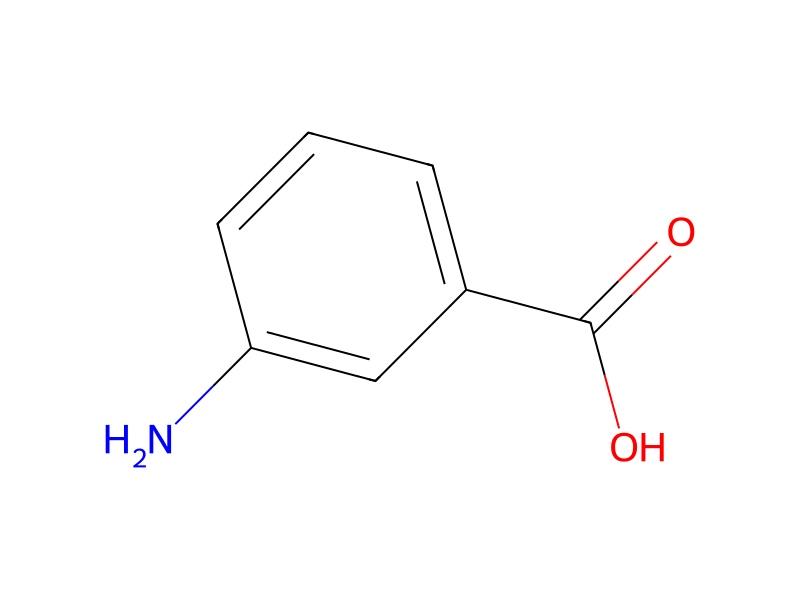
[CH3:1][S:2]C1C=C2C(=CC=1)C=NCC2.N[C:14]1[CH:15]=[C:16]([CH:20]=[CH:21][CH:22]=1)[C:17]([OH:19])=[O:18].O(CC)C([S-])=S.[Na+].S(OC)(OC)(=O)=O>>[CH3:1][S:2][C:14]1[CH:15]=[C:16]([CH:20]=[CH:21][CH:22]=1)[C:17]([OH:19])=[O:18]Participants



Procedure
Scheme 3 depicts the synthesis of 6-methylsulfanyl-3,4-dihydro-isoquinoline (XII). 3-Amino-benzoic acid (IV) is diazotized, reacted with sodium ethyl xanthate, followed by saponification, and is alkylated with dimethyl sulfate to give 3-methylsulfanyl-benzoic acid (V). This acid is reduced with Red-Al® (sodium bis (2-methoxyethoxy) aluminum hydride in toluene, Aldrich, Milwaukee, Wis., USA) to yield the alcohol (VI) which is converted to a benzyl chloride (VII) using thionyl chloride. The benzyl nitrile compound (VIII) is synthesized by treating (VII) with potassium cyanide in the presence of 18-crown-6. Standard reduction conditions (e.g., Raney nickel) gives phenethyl carbamate (IX), and deprotection yields the phenethylamine (X). (XI) is obtained by treating (X) with ethyl formate, followed by ring closure using phosphorus oxychloride to give the desired dihydroisoquinoline (XII).
Sources & evidence
- ORD record
- ord-a4d6eddc81654329b7c3a61586ee9b40
- Source dataset
- uspto-grants-2004_11
- Patent number
- US06812228B2
Reaction notes
Loading…