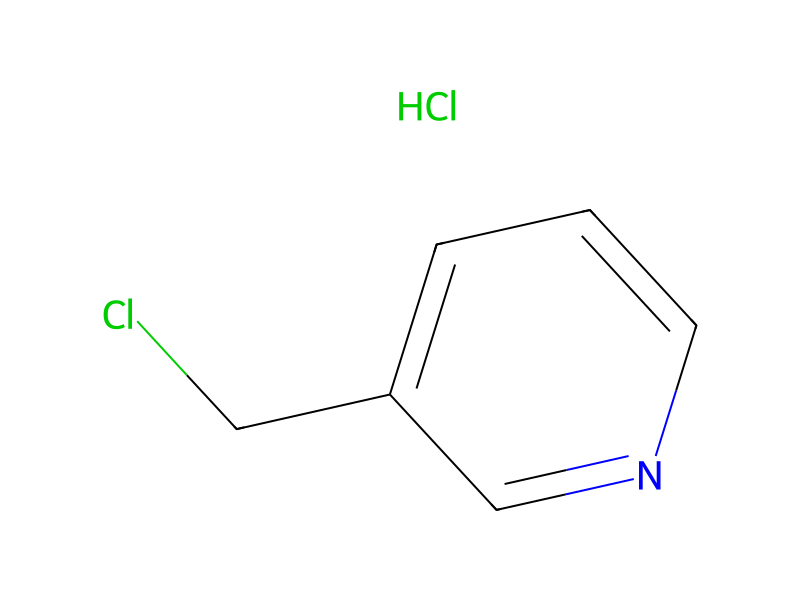
3-(Chloromethyl)pyridine hydrochloride → 2-Methyl-7-(pyridin-3-ylmethoxy)-4-pyrrolidin-1-yl-quinoline
Reaction equation

[CH3:1][C:2]1[CH:11]=[C:10]([N:12]2[CH2:16][CH2:15][CH2:14][CH2:13]2)[C:9]2[C:4](=[CH:5][C:6]([OH:17])=[CH:7][CH:8]=2)[N:3]=1.Cl.Cl[CH2:20][C:21]1[CH:22]=[N:23][CH:24]=[CH:25][CH:26]=1>>[CH3:1][C:2]1[CH:11]=[C:10]([N:12]2[CH2:16][CH2:15][CH2:14][CH2:13]2)[C:9]2[C:4](=[CH:5][C:6]([O:17][CH2:20][C:21]3[CH:22]=[N:23][CH:24]=[CH:25][CH:26]=3)=[CH:7][CH:8]=2)[N:3]=1Participants
3


Procedure
In analogy to example 6 there was prepared: on reaction of 2-methyl-4-pyrrolidin-1-yl-quinolin-7-ol with 3-(chloromethyl)pyridine hydrochloride, whereby the product was isolated as free base, 2-methyl-7-(pyridin-3-ylmethoxy)-4-pyrrolidin-1-yl-quinoline as a red solid. ISP mass spectrum, m/e: 320.4 (M+1 calculated for C22H21N3O: 320).
Workup
- customIn analogy to example 6 there was prepared
Sources & evidence
- ORD record
- ord-6e22b4fb51b441d3b330747c69354f18
- Source dataset
- uspto-grants-2004_11
- Patent number
- US06818767B2
Reaction notes
Loading…